
By Zubair
Lahore
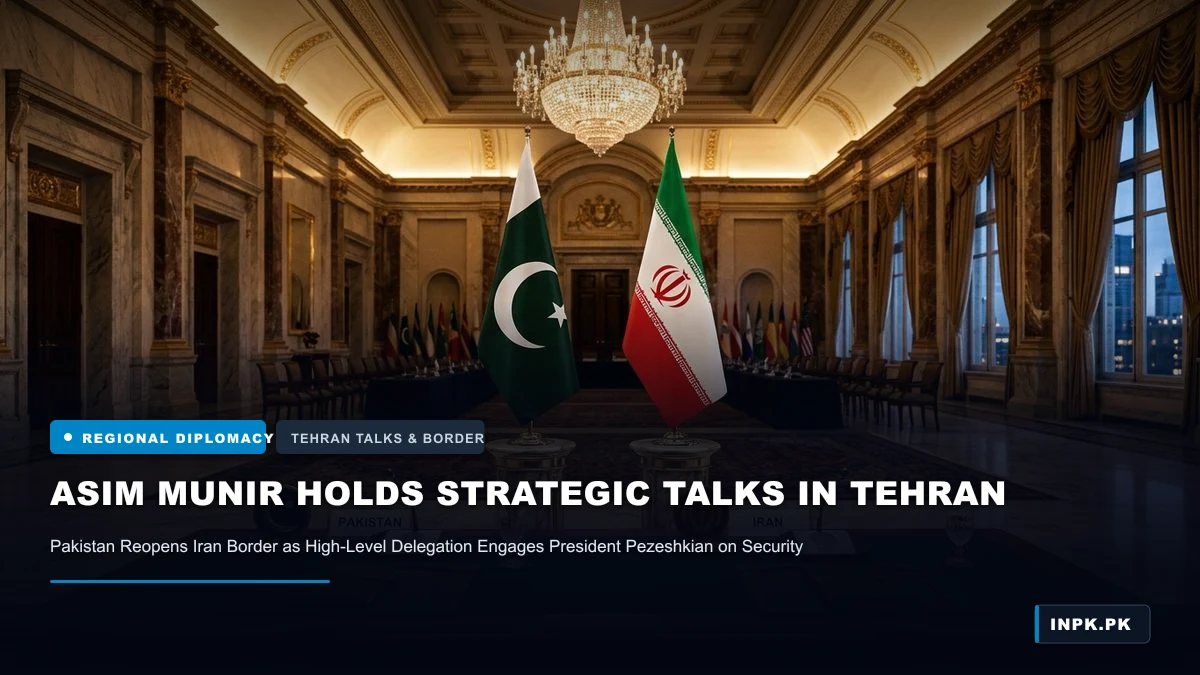
In a critical diplomatic mission aimed at defusing regional tensions and safeguarding shared economic frontiers, Pakistan Chief of Defence Forces and Army Chief, Field Marshal Asim Munir, has concluded high-level strategic consultations in Tehran. Accompanied by Federal Minister for Interior Mohsin Naqvi and senior security officials, Field Marshal Munir engaged in extensive discussions with Iranian President Masoud Pezeshkian, Parliament Speaker Mohammad Bagher Ghalibaf, and Supreme National Security Council Secretary Mohsen Rezaei.
The visit marked a concerted diplomatic initiative by Islamabad to facilitate communication channels amidst escalating geopolitical friction across the Middle East. Central to the bilateral agenda was the formal agreement to fully restore operational commercial activities and normalize transit operations across key border terminals, following localized security reviews along the 900-kilometer frontier separating Balochistan and Sistan-Baluchestan.
Strategic Dialogues on Regional Stability and De-escalation
During the delegation-level deliberations at the Presidential Palace in Tehran, Field Marshal Asim Munir and President Masoud Pezeshkian reviewed the evolving security landscape. Pakistani officials reiterated Islamabad's commitment to diplomatic mediation, highlighting that broader regional conflict threatens energy security, cross-border commercial corridors, and developing economies across South and West Asia.
Iranian authorities articulated their security perspectives, reiterating sovereignty conditions while expressing appreciation for Pakistan's constructive regional posture. Both sides underscored the necessity of close intelligence coordination to prevent non-state hostile elements from exploiting remote border corridors. The leadership affirmed that robust bilateral mechanisms are essential to prevent misunderstandings and sustain long-term stability.
Border Security Architecture and Border Terminals Normalization
A tangible operational milestone achieved during the talks was the comprehensive review and full resumption of commercial traffic at formal border crossings, including Taftan-Mirjaveh and Gabd-Rimdan. Addressing earlier temporary closures, Field Marshal Munir assured Iranian civil and military counterparts that recent administrative holds were temporary and technical in nature, designed to implement enhanced scanning protocols and intercept cross-border smuggling networks.
Interior Minister Mohsin Naqvi and Iranian security leadership agreed to intensify meetings of the Joint Border Commission, expand biometric verification mechanisms for cargo drivers, and operationalize joint border liaison offices. The measures aim to bolster bilateral trade, which both capitals target to expand to $10 billion annually through formalized banking channels and barter trade agreements.
Balancing Geopolitical Pacts and Regional Security
Pakistan's active engagement with Tehran highlights Islamabad's calibrated foreign policy approach, balancing fraternal ties with Gulf partners under multilateral defense cooperation agreements while simultaneously maintaining open, cooperative channels with its western neighbor. By reinforcing mutual border security protocols, Islamabad and Tehran seek to ensure that their shared perimeter remains an avenue of economic opportunity rather than instability. For ongoing updates on defense diplomacy and national security, explore our national news archives and follow comprehensive geopolitical and foreign policy coverage.