
By Web Desk
New York
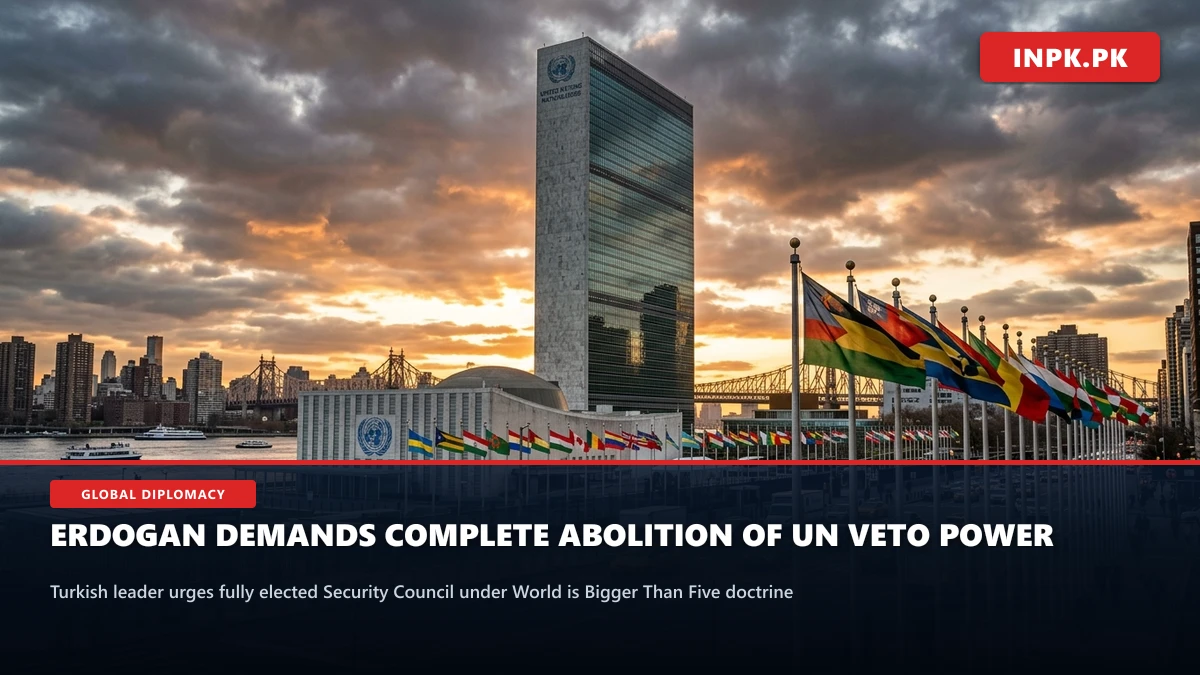
Turkish President Recep Tayyip Erdogan has launched a sweeping diplomatic offensive at the United Nations General Assembly, formally demanding the complete abolition of the veto power wielded by the five permanent members of the UN Security Council and calling for the total restructuring of global governance under his long-championed doctrine, "The World is Bigger Than Five."
Addressing world leaders and delegates during the high-level general debate of the 81st UN General Assembly session in New York, Erdogan warned that the international security architecture established in the aftermath of World War II has collapsed into systemic paralysis. The Turkish leader asserted that the unchecked veto privilege held by Britain, China, France, Russia, and the United States has reduced the United Nations to a bystander while humanitarian atrocities and regional wars escalate unchecked.
"A Handful of Capitals Cannot Hold Humanity Hostage"
In a forceful, uncompromising address delivered from the green-marble rostrum, Erdogan pointed to repeated Security Council deadlocks over ongoing conflicts in the Middle East, Eastern Europe, and Africa as definitive evidence that the current executive structure serves narrow geopolitical interests rather than collective international peace.
"The veto privilege is not diplomacy; it is an institutionalized injustice," Erdogan declared to the packed assembly hall. "The fate and security of more than 190 member nations cannot remain hostage to the domestic politics or geopolitical calculations of a handful of capitals. If the United Nations is to maintain any shred of moral legitimacy, the abolition of the veto power must be recognized as the starting point and non-negotiable strategic objective of comprehensive reform."
Elaborating on the proposal in an extensive policy essay published concurrently by Bloomberg titled "The Quest for Global Justice in a Changing World," the Turkish president outlined a blueprint for an entirely reformed Security Council. Under the Ankara framework, the concept of permanent membership would be completely eliminated in favor of a 20- to 25-member council elected entirely by the General Assembly for defined, rotating multi-year terms.
Democratic Accountability and General Assembly Primacy
Under Erdogan reform plan, member states seeking re-election to the executive council would be required to secure the democratic endorsement of the wider General Assembly, ensuring that council members remain accountable to the collective will of the international community. The proposal also mandates the elimination of unilateral vetoes, replacing them with qualified majority voting thresholds.
"Power without accountability breeds impunity," Erdogan argued during subsequent press engagements at the Turkish House in Manhattan. "An architecture where five nations hold absolute negative authority while the General Assembly represents the collective conscience of humanity without enforceable authority is fundamentally incompatible with the 21st century."
The Turkish initiative received immediate and vocal praise from developing nations across Latin America, Africa, and Asia, whose representatives have long protested their systematic exclusion from primary crisis-resolution mechanisms. Senior diplomats from non-aligned and regional blocs commended the clarity of the proposal, noting that decades of incremental discussions on Security Council expansion have yielded no practical reform.
Resistance from Permanent Members and the Path Forward
Despite growing momentum among General Assembly member states, meaningful structural reform faces formidable procedural barriers. Any formal amendment to the United Nations Charter requires ratification by two-thirds of the General Assembly as well as approval by all five permanent members of the Security Council, effectively granting each veto-holding capital the legal authority to block reforms targeting its own privileges.
While Western diplomats acknowledged the urgent need for council modernization, representatives from permanent member delegations signaled hesitation regarding the complete elimination of veto prerogatives, contending that permanent seats provide essential stability among major nuclear-armed powers. However, Turkish officials countered that preserving the status quo guarantees the continued erosion of international law and multilateral institutions.
Erdogan announced that Turkiye will sponsor a formal resolution during the current session to convene an extraordinary international conference on UN Charter reform, challenging world leaders to align their public commitments to democracy with concrete structural reform.
Follow unfolding diplomatic initiatives, United Nations debates, and multilateral governance summits with continuous coverage on INPK world news coverage and comprehensive analysis at INPK international diplomacy.