
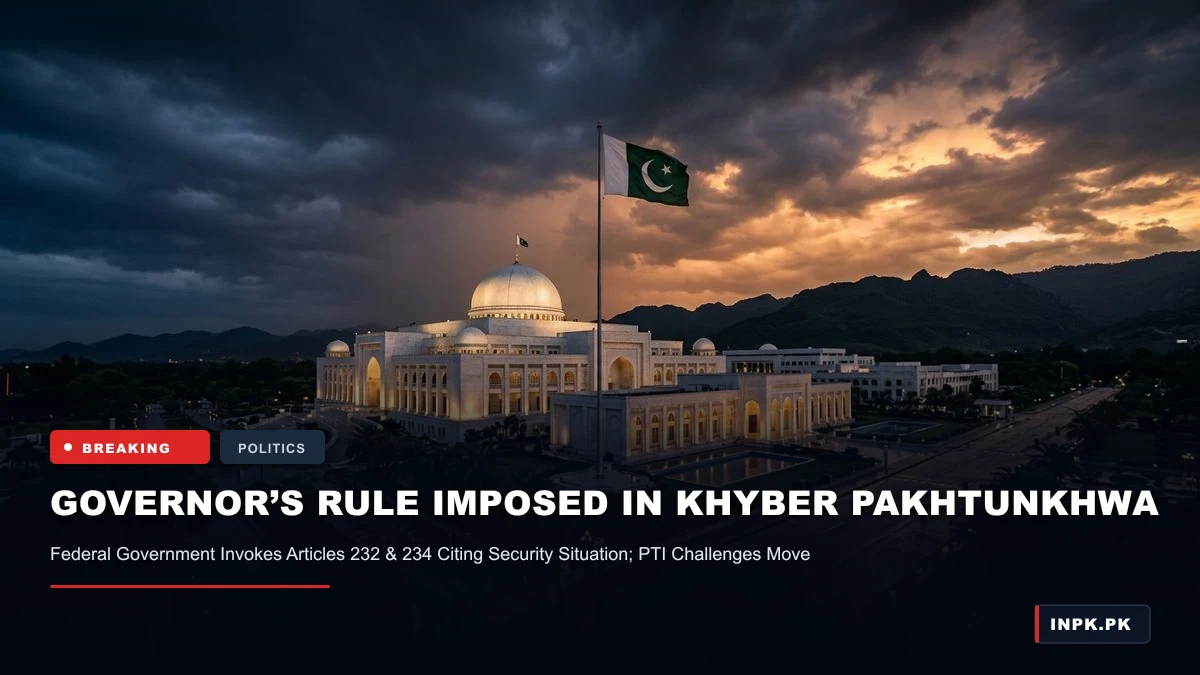
ISLAMABAD — In a momentous political and constitutional development, the federal government of Pakistan has officially imposed Governor’s Rule across Khyber Pakhtunkhwa and declared a state of emergency in twelve districts of the province, invoking the extraordinary powers enshrined in Articles 232 and 234 of the Constitution.
The sweeping decision, ratified during an emergency federal cabinet session chaired by Prime Minister Shehbaz Sharif in Islamabad, immediately suspends the executive authority of the provincial cabinet led by Chief Minister Sohail Afridi. Under the constitutional proclamation, administrative authority over the province has been transferred to Governor Faisal Karim Kundi, who will oversee provincial affairs with the assistance of a newly constituted eleven-member Advisory Council.
Constitutional Framework and Federal Proclamation
The formal gazette notification issued by the Cabinet Division detailed that the federal administration acted upon formal assessments submitted by the Ministry of Interior, the National Counter Terrorism Authority (NACTA), and intelligence apparatuses regarding severe security and governance bottlenecks in the province.
Article 232 of the Constitution of Pakistan empowers the President, acting on the advice of the Prime Minister, to issue a Proclamation of Emergency when the executive authority is satisfied that a grave emergency exists in which the security of Pakistan, or any part thereof, is threatened by war, external aggression, or internal disturbances beyond the power of a provincial government to control.
Concurrently, the federal government invoked Article 234, which allows the President to assume all or any of the functions of the government of the province upon receipt of a report indicating that the provincial administration cannot be carried on in accordance with the provisions of the Constitution. To reinforce law enforcement infrastructure, the federal government simultaneously authorized the deployment of the armed forces in aid of civil power under Article 245 of the Constitution.
Administrative Realignment and Governance Measures
Following the proclamation, senior administrative restructuring was enacted immediately across the civil secretariat in Peshawar. The federal government notified the appointment of Dr. Muhammad Fakhr Alam Irfan as the new Chief Secretary of Khyber Pakhtunkhwa, replacing the outgoing administrative leadership.
According to official directives from the Governor’s Secretariat, the eleven-member Advisory Council will oversee key administrative portfolios, including finance, home affairs, counterterrorism coordination, municipal infrastructure, and health services, ensuring uninterrupted public delivery while the provincial assembly’s legislative operations remain suspended.
Security Rationale and Counterterrorism Mandate
Briefing media representatives in Islamabad, federal ministers emphasized that the invocation of emergency provisions was necessitated by escalating counterterrorism exigencies and what the center characterized as an institutional disengagement between the provincial executive and federal security organs.
Federal officials pointed to an alarming surge in violent cross-border militant incursions and high-profile security threats targeting law enforcement infrastructure across southern and tribal districts of Khyber Pakhtunkhwa over recent weeks. The federal government maintained that persistent policy divergence and administrative inaction had paralyzed provincial counterterrorism operations, creating an imperative for centralized operational alignment under the Governor’s administrative umbrella.
PTI Condemnation and Constitutional Challenges
The leadership of Pakistan Tehreek-e-Insaf (PTI) strongly denounced the imposition of Governor’s Rule, characterizing the proclamation as an unconstitutional usurpation of the democratic mandate delivered by the people of Khyber Pakhtunkhwa.
Addressing an emergency press conference, senior PTI leaders and parliamentarians labeled the measure a calculated political assault aimed at suppressing provincial autonomy and stifling political mobilization. The party contended that the federal government had manufactured security pretexts to derail provincial governance and clamp down on opposition lawmakers, several of whom were detained amidst simultaneous protest marches heading toward the federal capital.
PTI legal teams confirmed that urgent constitutional petitions have been finalized for filing before the Supreme Court of Pakistan and the Peshawar High Court, challenging the factual veracity of the presidential proclamation under Articles 232 and 234, and requesting immediate judicial intervention to restore the elected provincial administration.
Parliamentary Repercussions and Legal Scrutiny
Constitutional experts noted that while the federal government possesses executive prerogatives to issue emergency proclamations, Article 232 and Article 234 mandate that such proclamations must be laid before a joint sitting of Parliament for approval within specified constitutional timeframes. Failure to obtain parliamentary ratification within the prescribed timeline would lead to the automatic lapse of the proclamation unless extended through statutory parliamentary procedures.
The confrontation has injected fresh volatility into Pakistan’s political landscape, polarizing the National Assembly and Senate as opposition alliances pledge coordinated resistance on the floor of both houses. With security deployments intensifying across provincial boundaries and judicial benches preparing to hear urgent constitutional challenges, the standoff marks one of the most critical legal and political tests for inter-governmental relations in recent Pakistani history.