
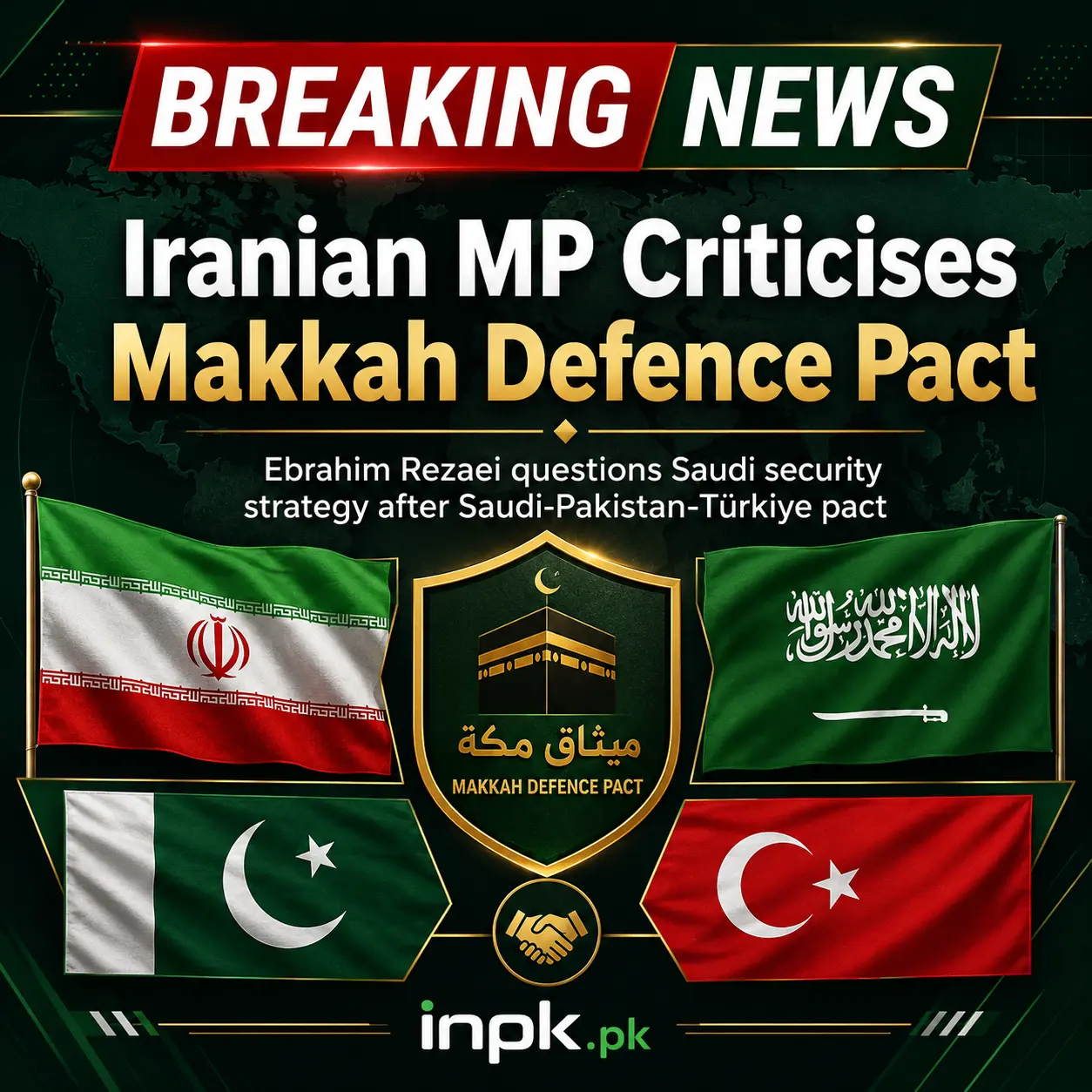
TEHRAN/RIYADH — Iranian lawmaker Ebrahim Rezaei has criticised the newly signed defence agreement between Saudi Arabia, Pakistan and Türkiye, questioning whether the trilateral arrangement will provide Riyadh with greater security amid heightened tensions across the Middle East.
Rezaei, who serves as spokesperson for the Iranian Parliament’s National Security and Foreign Policy Commission, made the remarks on X on Friday following the signing of the Makkah Joint Defence Agreement.
His comments represent one of the first significant political reactions from Iran to the new security arrangement, although they should not be interpreted as an official statement from the Iranian government or leadership.
As of Friday, no formal response to the pact had been issued by Iran’s senior leadership, according to reporting on the agreement.
Rezaei Criticises Saudi Reliance on External Security Partners
In his social media statement, Rezaei argued that Saudi Arabia should reconsider its policies rather than depend on security arrangements with foreign states.
He described the new agreement with Pakistan and Türkiye as a “paper agreement” and questioned whether it would improve Saudi Arabia’s security.
Rezaei also compared the arrangement with Riyadh’s longstanding security relationship with the United States, arguing that previous dependence on Washington had not produced the security Saudi Arabia sought.
He then urged Saudi authorities to reform their policies so they would not have to seek security from other countries.
Al Jazeera reported the remarks shortly after the agreement was signed and identified Rezaei as an Iranian member of parliament. Iranian and regional reporting also identifies him as spokesperson for parliament’s National Security and Foreign Policy Commission.
What Is the Makkah Joint Defence Agreement?
Saudi Arabia, Pakistan and Türkiye signed the new trilateral defence agreement in Makkah on Friday, August 7, 2026.
Saudi Crown Prince and Prime Minister Mohammed bin Salman, Pakistan Prime Minister Muhammad Shehbaz Sharif and Turkish President Recep Tayyip Erdoğan participated in the high-level summit surrounding the agreement.
Pakistan’s Ministry of Foreign Affairs also officially announced the Makkah Al-Mukarramah Summit for Joint Defence on August 7.
The central provision of the agreement establishes a collective-defence principle between the three countries.
According to the joint statement reported by Reuters, an armed attack against any one of the three states would be regarded as an attack against all three.
The agreement is intended to strengthen collective deterrence and defence cooperation while promoting security and stability in the region.
A Turkish official told Reuters that the agreement was defensive in nature and was not directed against any particular country or actor.
The official also said the agreement does not replace the countries’ existing bilateral or multilateral commitments and could potentially remain open to participation by other regional states.
Does the Pact Mean an Iranian Attack on Saudi Arabia Would Involve Pakistan and Türkiye?
The agreement significantly changes the political and strategic calculation surrounding any future armed attack on one of its members.
On the wording released so far, an armed attack against Saudi Arabia would be treated under the pact as an attack against Pakistan and Türkiye as well.
That makes the agreement relevant to current tensions involving Iran and Iran-aligned armed groups because Saudi territory has faced missile and drone attacks during the wider regional conflict.
Reuters reported that Iran and allied groups have attacked Saudi Arabia and other Gulf states since the major escalation that followed U.S. and Israeli strikes against Iran on February 28, 2026.
However, an important distinction remains.
The public description of the Makkah agreement does not yet specify exactly what military action each member would be required to take following an attack.
It therefore cannot presently be stated that every attack on Saudi Arabia would automatically produce a Pakistani or Turkish military strike against the attacker.
Questions including attribution of an attack, consultation between the three governments, the scale of an appropriate response and the circumstances under which military force could be used remain important.
This is particularly relevant in cases involving armed groups rather than attacks openly carried out by another state.
No Public Evidence of Automatic Pakistani Nuclear Guarantee
Pakistan’s participation has also drawn particular attention because Pakistan possesses nuclear weapons.
Reuters described Pakistan as the Muslim world’s only nuclear-armed state, while Türkiye has NATO’s second-largest military and Saudi Arabia brings considerable economic and strategic weight to the partnership.
However, the fact that Pakistan is a nuclear-armed state should not be interpreted as evidence that the Makkah agreement automatically places Saudi Arabia or Türkiye under a Pakistani nuclear umbrella.
The publicly available details of the agreement do not specify a nuclear guarantee.
They also do not state that nuclear weapons would form part of any response to aggression.
For that reason, claims that an attack on Saudi Arabia would automatically trigger a Pakistani nuclear response go beyond what has so far been officially disclosed.
The clearer and more defensible conclusion is that the pact raises the potential political and military cost of aggression by formally linking the security interests of three major regional states.
Iran Not Named as Target of Agreement
Despite Rezaei’s criticism and the wider regional tensions involving Tehran, Iran is not identified as the target of the Makkah agreement.
A Turkish official specifically told Reuters that the agreement was not directed against any individual actor.
Nevertheless, the timing of the agreement has inevitably focused attention on Iran.
Saudi Arabia has faced security threats involving Iran and Iran-aligned groups, including Yemen’s Houthis and armed groups operating in Iraq.
Reuters reported that Riyadh had recently been preparing for the possibility of coordinated attacks by Iraqi militias and the Houthis, highlighting the immediate security environment surrounding the signing of the agreement.
Al Jazeera similarly reported that Saudi Arabia had come under attack from Iran and its regional allies during the current conflict and said concerns over regional instability contributed to the negotiations among Riyadh, Islamabad and Ankara.
Rezaei Holds Influential Parliamentary Security Role
Ebrahim Rezaei is not merely an ordinary member of the Iranian parliament.
Iranian media has identified him as spokesperson for the Parliament’s National Security and Foreign Policy Commission, a parliamentary body dealing with major national security and external affairs issues.
In recent months, Rezaei has publicly addressed Iran’s nuclear policy, the Strait of Hormuz and the country’s response to regional military developments.
His criticism of the Makkah pact therefore carries political significance.
At the same time, statements by an individual parliamentarian—even one holding a senior commission role—remain distinct from a formal policy declaration by Iran’s president, foreign ministry, military leadership or other senior state authorities.
Makkah Pact Adds New Layer to Regional Security
The agreement brings together three countries with different but complementary strategic capabilities.
Türkiye possesses a major conventional military and a rapidly expanding defence industry.
Pakistan has extensive military experience, a significant defence industry and an independent nuclear deterrent.
Saudi Arabia brings major financial resources, strategic geography and considerable regional diplomatic influence.
The three countries also maintained substantial bilateral defence relationships before Friday’s agreement.
Analysts cited by international media have described the pact as potentially contributing to a more regionally driven security architecture, particularly as Middle Eastern governments reassess their reliance on traditional external security guarantees.
What Happens Next?
The most important unanswered questions now concern implementation.
The three governments have yet to publicly explain the detailed mechanisms that would govern the collective-defence clause, including how an armed attack would be formally identified, what consultations would follow and what level of military assistance members would be expected to provide.
Further details may also clarify whether the agreement will involve permanent joint institutions, intelligence-sharing arrangements, coordinated air and missile defence, military exercises, defence production projects or other operational cooperation.
For now, the confirmed position is that Pakistan, Saudi Arabia and Türkiye have formally agreed that an armed attack against one will be regarded as an attack against all three.
Rezaei’s criticism shows that the agreement is already drawing close attention in Tehran, but his remarks remain a parliamentary political reaction rather than an announced official Iranian government response.
This is a developing story and may be updated as Iran, Pakistan, Saudi Arabia or Türkiye release further official statements about the agreement.