
By Web Desk
Moscow
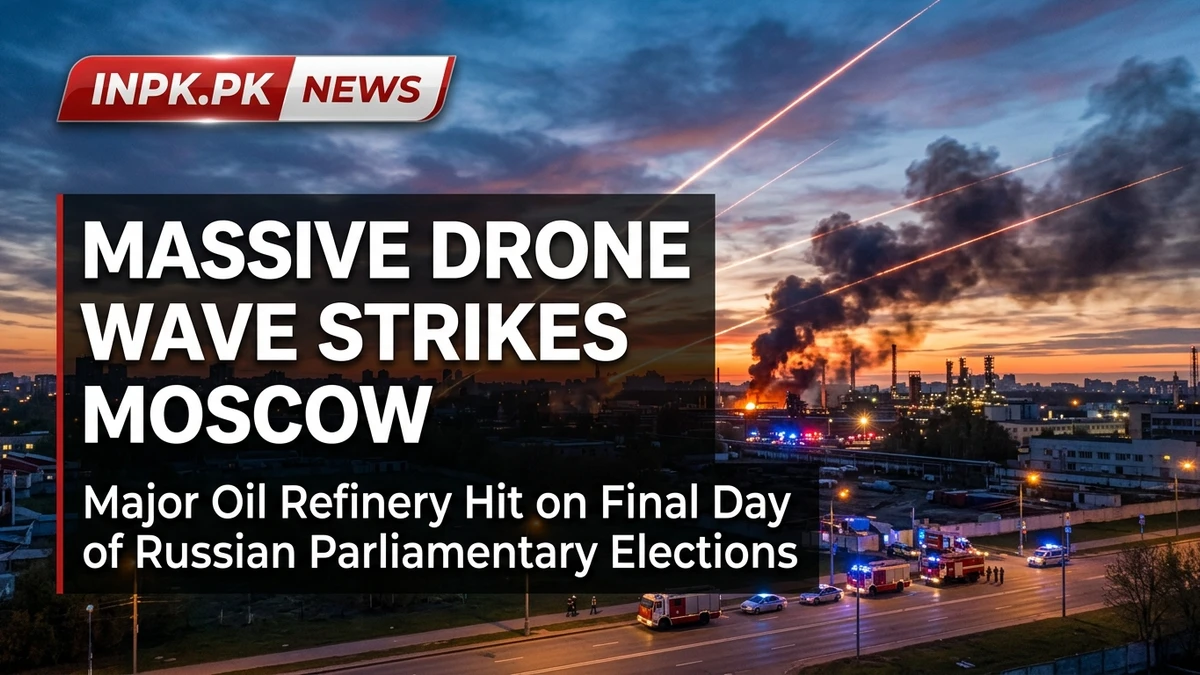
The Russian capital and surrounding metropolitan districts were targeted by an unprecedented barrage of long-range aerial drones on Sunday morning, marking the most extensive drone assault on Moscow since the beginning of the war in Ukraine. The strikes coincided with the third and concluding day of nationwide parliamentary voting for the Russian State Duma.
According to official statements from the Russian Ministry of Defense and Moscow Mayor Sergei Sobyanin, air defense units engaged and intercepted more than 1,600 drones nationwide over a 24-hour period, with approximately 450 unmanned aerial vehicles specifically directed toward targets in the Moscow region. Despite intercept efforts, falling debris and direct impacts ignited a major blaze at the Moscow Oil Refinery in the southeastern district of Kapotnya and caused structural damage to residential apartment complexes in suburban districts.
Oil Infrastructure Targeted in Kapotnya District
Emergency response crews, including dozens of specialized firefighting brigades and aerial water-dropping helicopters, were deployed to the Moscow Oil Refinery after drone debris struck an auxiliary refining unit, sending dense columns of black smoke visible across central Moscow. State emergency services reported that automatic shut-off protocols contained the fire from spreading to central crude storage reservoirs.
The strike on the Kapotnya refinery underscores Ukraine's continuing strategic emphasis on degrading Russian domestic hydrocarbon processing capacity. Repeated strikes against Russian refineries in recent months have strained domestic fuel distribution networks and heightened supply volatility across regional wholesale markets.
Civilian Impact and Airport Groundings
Beyond industrial targets, local authorities confirmed that drone fragments struck a 21-story residential tower in the Ramenskoye district of Moscow Oblast, sparking fires across multiple floors. Emergency management personnel evacuated over 400 residents, with regional healthcare officials confirming at least two fatalities and approximately 20 individuals treated for blast injuries and smoke inhalation.
The Federal Air Transport Agency (Rosaviatsiya) initiated temporary airspace closures and ground-stop protocols across Moscow's primary international aviation hubs—including Sheremetyevo, Domodedovo, and Vnukovo airports—diverting dozens of commercial passenger flights to alternate regional airfields before operations gradually resumed on Sunday afternoon.
Election Day Tension and Geopolitical Fallout
The large-scale assault unfolded as voters cast ballots on the final day of three-day parliamentary elections. Kremlin leadership had framed the election as a national referendum affirming widespread public support for the war effort, while independent observers noted that anti-war opposition candidates had been disqualified from the ballot.
Mayor Sobyanin condemned the assault as a calculated effort to disrupt electoral procedures, maintaining that voting across municipal polling stations continued without interruption. Military analysts observe that the unprecedented scale of the drone wave demonstrates Ukraine's expanding domestic manufacturing capacity for long-range autonomous strike platforms capable of penetrating deep into heavily defended airspace around the Russian capital.
Readers can follow live military updates, energy infrastructure impacts, and international diplomatic reactions through continuous coverage on INPK world news coverage.