
By Web Desk
New York
Dozens of international diplomatic delegations staged a dramatic coordinated walkout from the United Nations General Assembly hall on Thursday as Israeli Prime Minister Benjamin Netanyahu approached the podium, prompting an immediate and combative rebuke in which the Israeli leader branded the departing diplomats as "moral cowards."
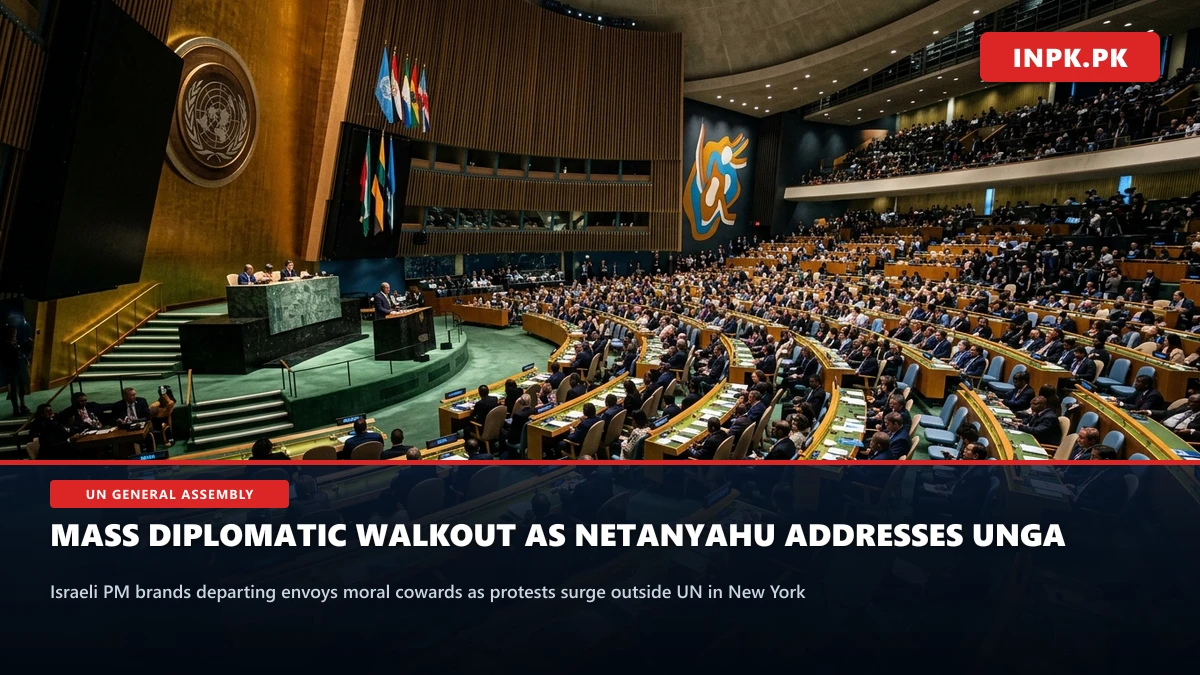
The mass demonstration unfolded in the opening moments of Netanyahu address to the 81st session of the General Assembly. As the session president announced the Israeli prime minister, ambassadors and senior envoys representing Arab, Muslim, European, and Latin American nations rose en masse from their desks, streaming toward the exit doors of the iconic green-marble hall while audible boos and scattered applause echoed across the gallery.
Verbal Confrontation from the General Assembly Rostrum
Netanyahu waited for several moments as the sound of footsteps and murmurs reverberated through the emptying auditorium. Standing at the central podium before a chamber populated by vast swaths of vacant green leather seats, the prime minister delivered an unscripted challenge directly to the remaining audience before commencing his prepared text.
"If there are any other moral cowards who have not yet left this hall, please do so now," Netanyahu declared, his voice carrying through the public address system as diplomatic security personnel observed the departing delegations. "The double standard applied to Israel inside this building has long ceased to be diplomacy; it has become an exercise in moral surrender."
The planned protest was coordinated by Palestinian representatives and supported by regional diplomatic blocs in response to catastrophic civilian casualties, infrastructure devastation, and widespread famine conditions resulting from prolonged military operations in the Gaza Strip. Envoys taking part in the walkout stated that remaining seated would have constituted tacit legitimization of systematic violations of international humanitarian law.
Defense of Military Operations and Defiance on Iran
Throughout his 40-minute address, Netanyahu mounted an uncompromising defense of his government military strategy across Gaza, Lebanon, and the wider Middle East. The prime minister categorically rejected international accusations of genocide brought before global tribunals, labeling the charges the "biggest lie of the century" orchestrated by geopolitical adversaries.
Netanyahu directed particular focus toward the Islamic Republic of Iran, asserting that Israel recent targeted military strikes against strategic facilities and ballistic missile sites had fundamentally altered the regional balance of power. Characterizing the decision to strike Iranian targets as necessary and unambiguous, the prime minister told the assembly that neutralizing emerging existential threats was "one of the easiest decisions I have ever had to make."
"Israel did not seek this conflict, but Israel will finish it with decisive victory," Netanyahu said. "We are fighting on seven fronts against forces dedicated to our annihilation. Those who lecture us from comfortable distances while ignoring sovereign self-defense understand neither history nor justice."
Widespread Street Protests and Mass Arrests Across Manhattan
The diplomatic confrontation inside the United Nations complex mirrored intense civil unrest on the streets of Midtown Manhattan. Thousands of demonstrators gathered along First Avenue and surrounding intersections, waving flags and demanding an immediate cessation of military hostilities and an international arms embargo.
The New York City Police Department deployed extensive counter-terrorism units, mobile fencing, and crowd-control barriers to contain escalating demonstrations outside the security perimeter. Police officials confirmed that more than 100 demonstrators were taken into custody throughout the afternoon following clashes near Dag Hammarskjold Plaza and 42nd Street, with charges ranging from disorderly conduct to obstruction of governmental administration.
Netanyahu also used his speech to criticize municipal leadership in New York, taking aim at local political figures who had supported the demonstrations. City officials pushed back against the prime minister characterizations, defending the constitutional rights of residents to engage in peaceful public assembly outside diplomatic installations.
Deepening Geopolitical Polarization at the United Nations
Diplomatic analysts noted that the walkout and the tenor of the address highlight an unprecedented degree of institutional fracture within the United Nations. With international legal mechanisms stalled and Security Council resolutions repeatedly vetoed, the General Assembly floor has increasingly transformed into a theater of direct diplomatic confrontation.
Several Western delegations that remained seated during the address expressed concern over the hardening rhetoric on both sides, warning that the absence of genuine diplomatic off-ramps risks widening regional hostilities across the Levant and Persian Gulf. Delegations from the Global South reiterated calls for urgent multilateral enforcement of international court rulings to protect vulnerable civilian populations.
Follow comprehensive international coverage, diplomatic developments, and Middle East reporting with continuous updates on INPK world news coverage and detailed policy analysis at INPK international politics.