
By Web Desk
Lahore
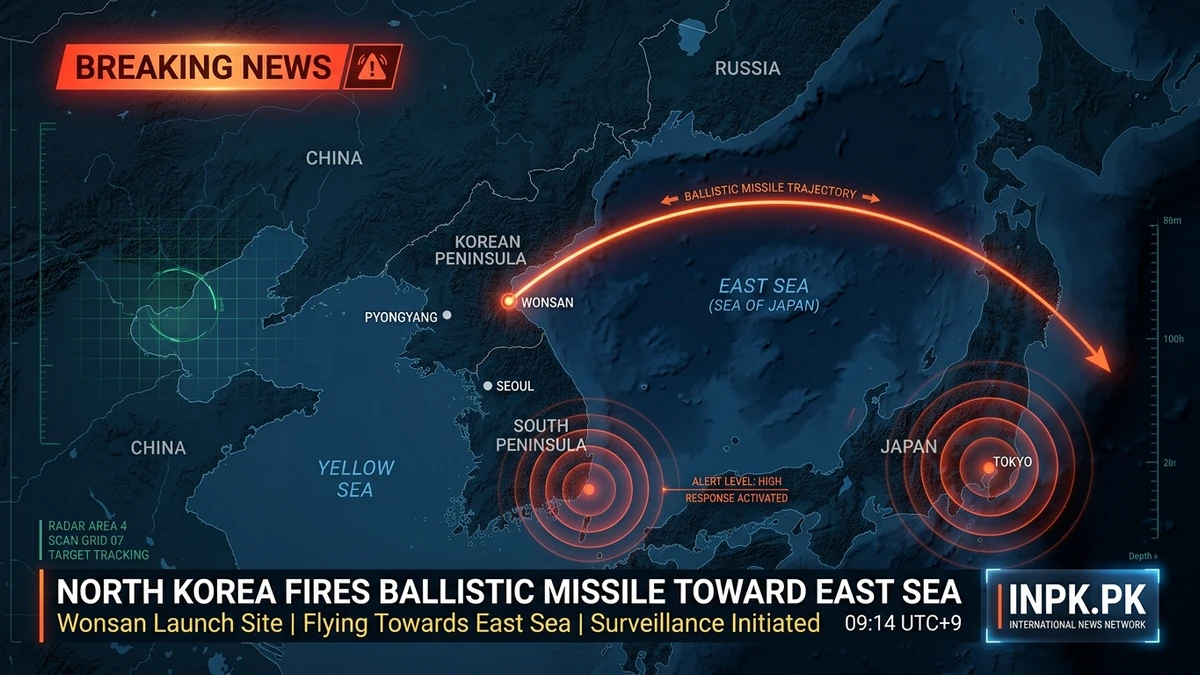
North Korea fired a ballistic missile toward the East Sea (Sea of Japan) on Sunday, military authorities in Seoul and Tokyo confirmed, marking Pyongyang's latest weapons test amid heightened geopolitical tensions and prompting South Korea's presidential office to convene an emergency national security council meeting.
South Korea's Joint Chiefs of Staff (JCS) announced that military surveillance detected the launch originating from the coastal region of Wonsan in Kangwon Province on Sunday morning. South Korean and United States intelligence agencies are conducting detailed technical analysis to assess the missile's exact flight distance, altitude, and velocity, while maintaining a heightened surveillance posture across the demilitarized zone.
Emergency Security Meetings in Seoul and Tokyo
Following the detection, South Korea's National Security Office convened an emergency situation assessment meeting to review operational readiness and evaluate potential secondary launches. South Korean defense officials condemned the test as a clear provocation that undermines peace and stability on the Korean Peninsula and directly violates multiple United Nations Security Council resolutions prohibiting North Korean ballistic missile activities.
In Tokyo, the Japanese Ministry of Defense reported that the projectile splashed into waters outside Japan's exclusive economic zone (EEZ). Prime Minister's office officials confirmed that no damage to maritime vessels or commercial aircraft was reported, though Coast Guard authorities issued urgent navigational safety advisories to ships operating across the Sea of Japan.
Defiance of UN Nuclear Watchdog and Diplomatic Context
The launch unfolds just days after North Korea's state media explicitly rejected a resolution passed by the International Atomic Energy Agency (IAEA) General Conference, which demanded that Pyongyang abandon its nuclear weapons programs and comply with international non-proliferation safeguards. North Korean diplomats characterized international inspections as an infringement on sovereign defense rights.
Strategic observers noted that the timing of Sunday's test appears deliberately calibrated ahead of the 81st Session of the United Nations General Assembly in New York, where regional non-proliferation, sanctions enforcement, and East Asian maritime security are scheduled for high-level deliberations among world leaders.
Deepening Regional Alliances and Deterrence Posture
The weapons test comes amid expanding trilateral defense cooperation between Washington, Seoul, and Tokyo, including integrated real-time missile warning data sharing and joint naval exercises. Pyongyang has repeatedly denounced allied maneuvers as rehearsals for preemptive invasion, warning that it will continue enhancing its strategic deterrent capabilities.
Readers can follow verified security updates, East Asian geopolitical developments, and United Nations General Assembly coverage on INPK news coverage as military commands finalize flight trajectory assessments.