
By Zubair
Lahore
Pakistan has reached the final stages of formulating its comprehensive regulatory and licensing framework for low-Earth-orbit (LEO) satellite broadband, paving the way for commercial rollouts by global mega-constellations including Starlink, Eutelsat OneWeb, and Amazon Project Kuiper.
Speaking at the Asia-Pacific Telecommunity (APT) symposium in Islamabad on Tuesday, Federal Minister for Information Technology and Telecommunication Shaza Fatima Khawaja confirmed that the government has finalized multi-stakeholder consultations. She stated that the landmark Fixed Satellite Services (FSS) policy will provide a business-friendly, transparent operating environment while firmly safeguarding national data sovereignty.
15-Year Licensing Regime and Local Ground Infrastructure Mandate
The regulatory blueprint developed by the Pakistan Telecommunication Authority (PTA) establishes a non-exclusive 15-year licensing category specifically tailored for next-generation satellite communications. Under the terms of the framework, international operators will be permitted to offer commercial high-speed broadband, corporate enterprise intranet connectivity, and cellular backhaul to local telecommunications providers.
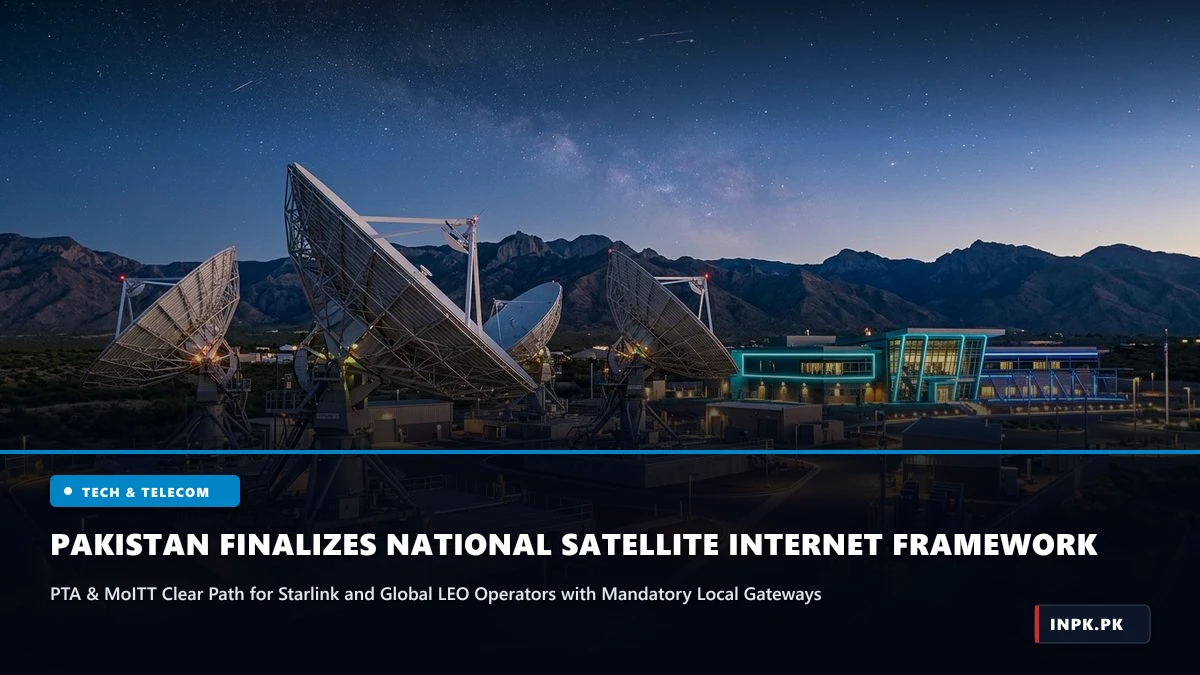
A central pillar of the regulatory architecture requires licensed satellite operators to construct and operate at least one physical Gateway Earth Station (GES) on Pakistani soil within 18 months of authorization. This requirement guarantees that all domestic telecommunications traffic originates and terminates through local internet exchanges, ensuring robust network resilience, lawful access compliance, and cybersecurity governance.
Bridging Digital Divides in Remote Mountainous and Rural Terrains
While Pakistan continues expanding terrestrial fiber networks—having deployed over 17,000 kilometers of high-capacity optical fiber through the Universal Service Fund (USF)—vast swathes of rugged mountainous terrain in Balochistan, Khyber Pakhtunkhwa, and Gilgit-Baltistan remain economically or geographically unviable for conventional physical cabling.
The introduction of constellation-based satellite internet is anticipated to transform remote healthcare delivery, enable digital distance learning in isolated villages, and support emergency communication networks during severe climate disasters. Furthermore, high-speed space broadband will provide rural software exporters and freelancers with low-latency gigabit connectivity previously confined to major metropolitan centers.
Phased Rollout and Strategic Telecom Roadmap
The initial licensing phase strictly targets fixed broadband and corporate enterprise links, while direct-to-device (D2D) smartphone satellite connectivity is slated for future regulatory phases once global spectrum coordination matures. Regulatory authorities are currently conducting final inter-ministerial security reviews before opening formal commercial license applications. For detailed coverage on Pakistan's digital connectivity initiatives, follow INPK technology news and economic infrastructure updates under national policy developments.