
By Zubair
Lahore
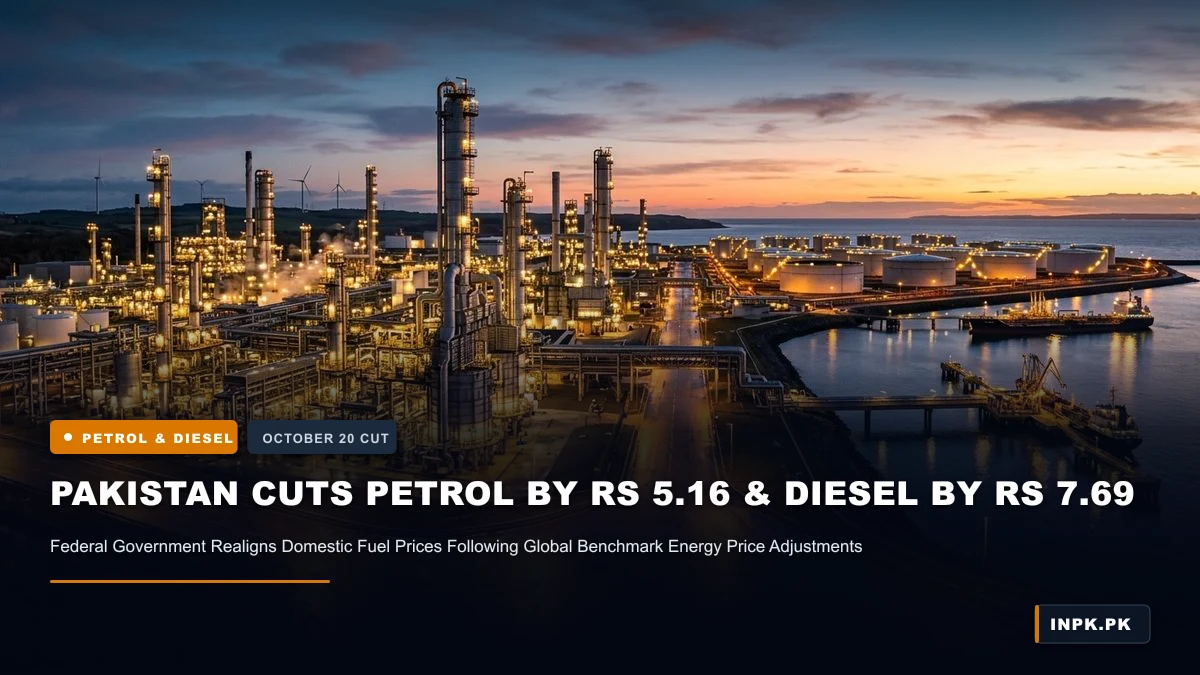
Providing measurable financial relief to motorists, commercial transport operators, and industrial consumers, the federal government has announced a substantial reduction in the retail prices of petroleum products across Pakistan. The price revision, notified by the Ministry of Energy (Petroleum Division) following formal determinations submitted by the Oil and Gas Regulatory Authority (OGRA), took effect from midnight on October 20, 2026.
Under the revised pricing framework, the ex-depot price of Motor Spirit (petrol) has been decreased by Rs 5.16 per litre, falling from Rs 386.30 to Rs 381.14 per litre. Concurrently, the price of High-Speed Diesel (HSD)—the primary fuel powering the national freight fleet, public passenger transit, and agricultural tubewells—has been slashed by Rs 7.69 per litre, dropping from Rs 396.96 to Rs 389.27 per litre.
International Oil Dynamics and Import Parity Calculations
Official calculations released by the Petroleum Division confirm that the price relief directly reflects downward adjustments in international Platts crude and refined product benchmarks over the preceding fortnight. Lower global oil import costs, combined with the stabilization of the Pakistani Rupee in the interbank currency exchange market, enabled authorities to pass the full net cost savings to end-users without altering existing petroleum development levy (PDL) structures.
Energy ministry officials highlighted that international benchmark prices for both gasoline and gasoil experienced softening due to increased non-OPEC crude output and balanced maritime shipping rates. The daily and fortnightly pass-through pricing mechanism ensures that domestic price movements remain strictly aligned with verified international import parity benchmarks rather than arbitrary administrative interventions.
Economic Relief for Transport and Agricultural Sectors
The downward revision in high-speed diesel prices comes at a pivotal period for Pakistan's rural economy, as farming communities across Punjab and Sindh commence land preparation and sowing for the winter wheat crop. Lower diesel expenditures directly reduce operational outlays for heavy tractors, harvesters, and irrigation tubewells, alleviating input cost pressures on agrarian yields.
Similarly, nationwide freight associations and urban public transit operators welcomed the reduction, noting that lower diesel overheads will ease logistics expenses on food supplies, raw materials, and manufactured goods. Economists project that the combined fuel price reductions will help suppress secondary transport costs and reinforce the ongoing moderation of national headline inflation. To track comprehensive energy notifications and economic trends, explore our national news archives and review continuous macroeconomic policy updates.