
By Zubair
Lahore
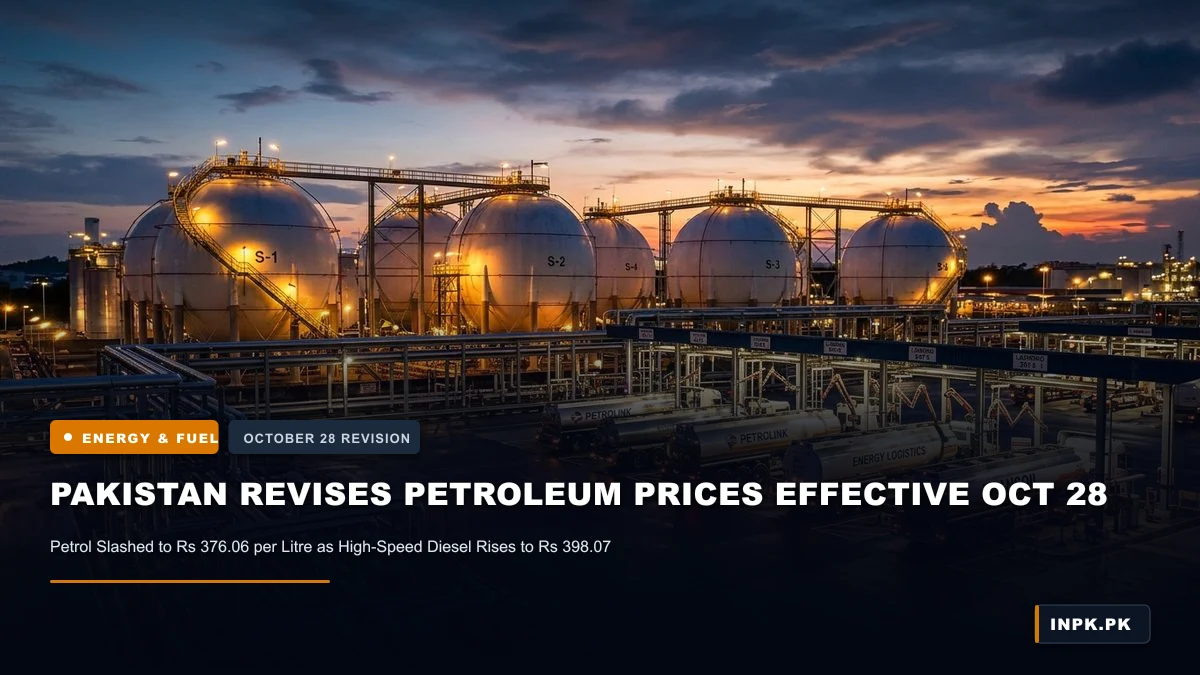
The Government of Pakistan has notified a targeted revision in the ex-depot prices of petroleum products effective Wednesday, October 28, 2026. Under the revised pricing framework computed by the Oil and Gas Regulatory Authority (OGRA) and approved by the Ministry of Energy (Petroleum Division), the consumer price of petrol has been reduced by Rs 3.19 per litre, while the price of high-speed diesel (HSD) has witnessed an upward adjustment of Rs 2.25 per litre.
Following the formal notification issued from Islamabad, the new retail price of petrol stands at Rs 376.06 per litre, down from Rs 379.25 per litre. Conversely, high-speed diesel, which serves as the primary fuel for mass transport fleets, commercial freight logistics, and agricultural machinery nationwide, will now retail at Rs 398.07 per litre, compared to its previous level of Rs 395.82 per litre.
International Benchmark Dynamics and Premium Fluctuations
Ministry officials explained that the divergence between petrol and diesel price movements reflects shifts in international benchmark crude prices and localized product import premiums. Over the preceding fortnight, benchmark gasoline prices experienced a modest softening across international trading hubs following partial de-escalation of regional shipping concerns in the Middle East and steady refinery output across Asian energy terminals.
In contrast, middle distillate demand, particularly for high-speed diesel, remained elevated due to seasonal heating inventory stockpiling in European markets and steady freight operations across regional trade corridors. The upward pressure on international diesel cargo benchmarks offset currency stability, necessitating the modest domestic adjustment to ensure full cost recovery for oil marketing companies (OMCs) and the national exchequer.
Impact on Commuters, Freight Haulage, and Agriculture
The reduction in petrol prices provides immediate financial breathing space for millions of individual commuters, motorcycle owners, urban ride-hailing operators, and small business owners navigating everyday transport costs. Commercial transport associations noted that lower petrol expenses will slightly ease urban mobility budgets across major metropolitan centres including Karachi, Lahore, Rawalpindi, and Peshawar.
However, transport operators expressed caution regarding the increase in diesel prices. High-speed diesel directly influences inter-city freight haulage, industrial supply chain transit, and agricultural tube-well operations. With wheat sowing season underway across Punjab and Sindh, farming representatives have urged provincial administrations to ensure subsidized electricity tariffs for agricultural connections to prevent the diesel increase from spilling over into localized farming operational overheads.
Government Revenue Framework and Petroleum Levy Status
Official finance documents indicate that the government maintained existing petroleum levy rates in line with macroeconomic commitments made under the International Monetary Fund (IMF) Extended Fund Facility (EFF). The petroleum levy remains an essential component of federal non-tax revenue mobilization, aimed at meeting quarterly fiscal consolidation targets while insulating public finances from sovereign borrowing spikes.
Energy analysts emphasized that domestic fuel pricing transparency remains vital for industrial stability and consumer predictability. Oil industry stakeholders have reaffirmed that domestic distribution depots possess sufficient fuel inventories to satisfy nationwide demand without interruption. For continuous analytical updates on national energy policies and price determinations, explore our national news archives and examine detailed economic governance reporting.