
By Zubair
Lahore
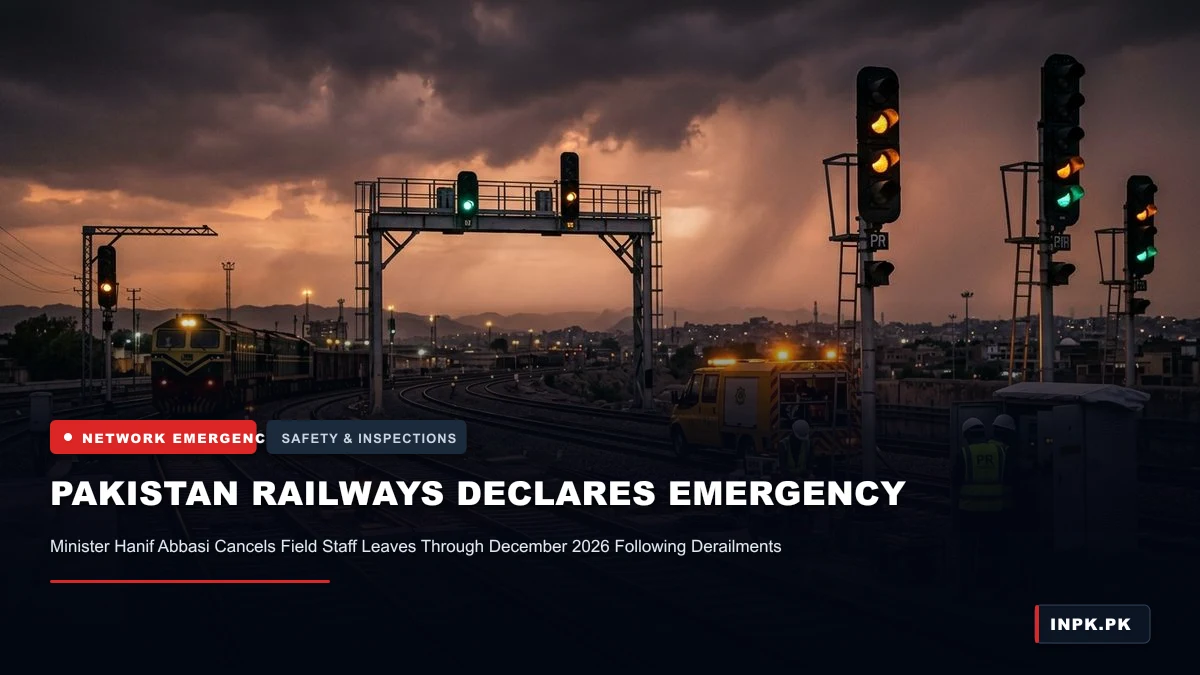
In a decisive move to address mounting operational vulnerabilities across the national rail transportation network, Federal Minister for Railways Hanif Abbasi has declared an official nationwide railway emergency across Pakistan, effective immediately through December 31, 2026. The extraordinary administrative intervention follows a sequence of severe derailments and safety breaches on primary passenger and freight routes, including a fatal train accident near the Sher Shah junction in Multan that claimed four lives and injured dozens.
The emergency proclamation establishes stringent operational protocols aimed at arresting track deterioration and enforcing strict administrative accountability across all regional railway divisions. Under the directives issued by the Ministry of Railways, all leaves for field officers, permanent way inspectors, signal engineers, and mechanical maintenance supervisors have been canceled for an initial duration of three months. Technical personnel deployed across the network have been ordered to remain stationed within their designated administrative sections to maintain continuous oversight.
Mandatory Daily Audits and Rolling Stock Inspection Protocols
Central to the emergency enforcement framework is the institutionalization of mandatory daily physical track inspections. Maintenance teams must execute comprehensive structural examinations of track geometry, fishplates, sleeper integrity, and ballast density across both mainline corridors and secondary branch lines before the clearance of scheduled passenger services. Divisional superintendents in Lahore, Karachi, Rawalpindi, Multan, Peshawar, Sukkur, and Quetta have been tasked with submitting certified daily safety compliance logs directly to the Railway Board headquarters.
In parallel with track surveillance, mechanical workshops in Moghalpura and carriage factories in Islamabad have been instructed to intensify stress testing on locomotive braking assemblies, wheel axles, and automatic signaling interfaces. Minister Hanif Abbasi clarified that recurring mechanical failures and signaling misalignments will no longer be classified as routine operational hazards, warning that technical negligence resulting in rolling stock disruptions will trigger immediate departmental inquiries and penal suspensions.
Mandatory Train Travel for Senior Railway Executives
To eliminate administrative disconnect between policy leadership and ground operations, the Ministry has instituted a mandatory travel directive for all senior railway executives. Under the new policy, divisional superintendents, chief operating superintendents, and department heads are strictly prohibited from utilizing road or air travel for official tours between division hubs, requiring them to commute exclusively aboard commercial passenger trains.
The directive is designed to compel high-ranking officials to experience real-time track vibrations, cabin safety standards, passenger facilities, and station-level security measures firsthand. Ministry officials noted that unexpected on-board inspections conducted by traveling directors will serve as a continuous evaluation mechanism for regional staff performance and train punctuality.
Accelerating Infrastructure Overhauls on Key Corridors
The operational emergency unfolds as Pakistan Railways intensifies coordination with international development partners, including the Asian Development Bank (ADB), to accelerate structural rehabilitation along the Main Line 1 (ML-1) Karachi-Peshawar arterial trunk. Long-standing financial constraints and historic flooding had deferred critical sleeper replacements across sensitive southern delta sectors, exacerbating vulnerability to derailments under heavy freight loads.
Emergency procurement mechanisms have been greenlit to replace worn track segments, refurbish hydraulic switches, and install modern automated track diagnostic sensors. Railway authorities confirmed that round-the-clock monitoring desks will function at the Ministry headquarters to oversee rapid response units and ensure that track maintenance targets are met without causing extended disruptions to passenger schedules. For continuous national infrastructure coverage and transport sector developments, explore our national news archives and examine detailed administrative policy analysis.