
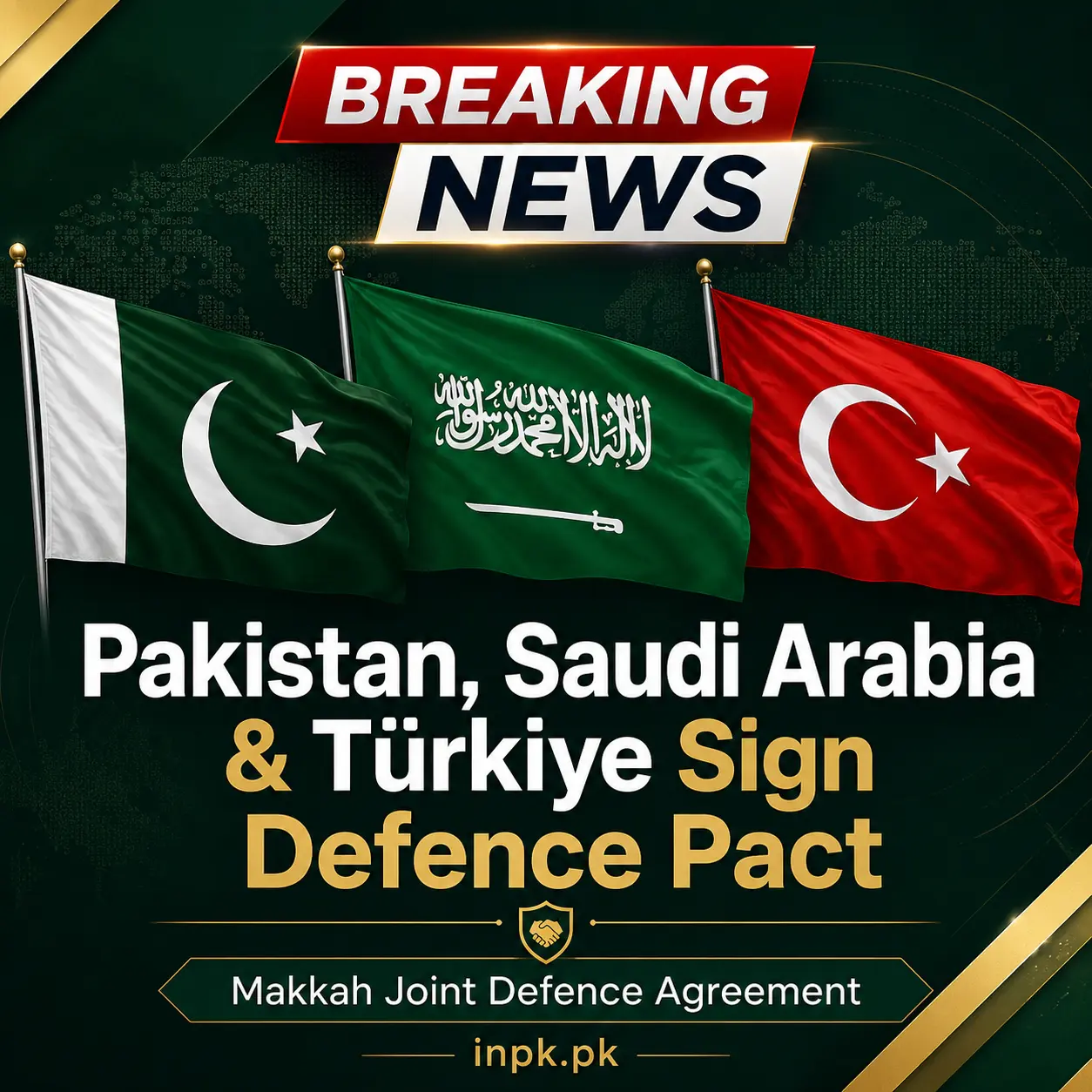
Pakistan, Saudi Arabia and Türkiye Sign Makkah Joint Defence Agreement
MAKKAH, Saudi Arabia — Pakistan, Saudi Arabia and Türkiye have signed the Makkah Joint Defence Agreement, establishing a new trilateral collective defence framework between the three countries at a time of heightened security concerns across the Middle East.
The agreement was signed in Makkah on Friday, August 7, following high-level diplomatic and security meetings involving Prime Minister Muhammad Shehbaz Sharif, Saudi Crown Prince and Prime Minister Mohammed bin Salman and Turkish President Recep Tayyip Erdoğan.
According to Pakistan’s Foreign Office statement reported by Pakistani media, the agreement provides that an armed attack against any one of the three participating states will be regarded as an attack against all three. The pact is intended to strengthen collective deterrence and expand defence cooperation between Pakistan, Saudi Arabia and Türkiye. Reuters also confirmed the signing of the agreement in Makkah.
Shehbaz Sharif Received by Mohammed bin Salman at Qasr Al-Safa
Before the signing, Prime Minister Shehbaz Sharif arrived at Qasr Al-Safa in Makkah Al-Mukarramah, where he was received by Saudi Crown Prince Mohammed bin Salman.
Broadcast footage from the meeting showed the Saudi crown prince welcoming the Pakistani prime minister before the two sides proceeded to high-level talks.
The Pakistani delegation participating in the meeting included Deputy Prime Minister and Foreign Minister Senator Mohammad Ishaq Dar, Defence Minister Khawaja Muhammad Asif and Chief of Army Staff and Chief of Defence Forces Field Marshal Syed Asim Munir.
The two leaders discussed Pakistan-Saudi relations, bilateral cooperation, defence ties, regional peace and other matters of mutual interest.
The meeting came during Prime Minister Shehbaz Sharif's official visit to Saudi Arabia and formed part of a wider round of consultations among the leadership of Pakistan, Saudi Arabia and Türkiye.
What Does the Makkah Joint Defence Agreement Say?
The central provision announced so far is a collective defence commitment.
Under the agreement, an armed attack against Pakistan, Saudi Arabia or Türkiye would be considered an attack against all three countries. The three sides said the arrangement was designed to strengthen their collective security and deterrence while supporting peace, security and stability in the wider region.
The agreement also provides a framework for broader defence cooperation among the three states.
However, the initial public statements have not detailed the precise military obligations each country would assume in the event that the collective defence clause is invoked. Specific mechanisms concerning deployments, joint command arrangements or operational procedures have also not yet been made public.
A Turkish official cited by Reuters described the pact as defensive rather than directed against a particular country and said it would not replace existing bilateral or multilateral arrangements.
Erdoğan Joins Shehbaz Sharif and Mohammed bin Salman
Turkish President Recep Tayyip Erdoğan also participated in the high-level engagement in Makkah and joined Prime Minister Shehbaz Sharif and Crown Prince Mohammed bin Salman in signing the agreement.
The signing brings together three countries that already maintain substantial bilateral political and military relationships but will now operate under an additional trilateral defence framework.
The three governments said the agreement was based on longstanding ties, shared strategic interests and existing defence cooperation.
Pakistan and Saudi Arabia Already Have a Mutual Defence Agreement
The latest trilateral agreement follows an earlier Strategic Mutual Defence Agreement between Pakistan and Saudi Arabia, signed during Prime Minister Shehbaz Sharif's state visit to Riyadh on September 17, 2025.
According to the official Pakistan-Saudi joint statement issued at the time, that agreement was intended to strengthen joint deterrence, with any aggression against either Pakistan or Saudi Arabia to be considered aggression against both countries.
The Makkah agreement therefore broadens the collective-security structure by bringing Türkiye into a new three-country framework.
Pakistan and Saudi Arabia have maintained defence cooperation for decades, while Pakistan and Türkiye also have longstanding military-to-military relations involving training and defence-industrial cooperation.
Regional Security Expected to Remain a Major Focus
The agreement comes as regional security has become a central subject in diplomatic engagements involving Pakistan, Saudi Arabia and Türkiye.
During the Shehbaz-Mohammed bin Salman meeting, regional developments and the situation in the Middle East were among the subjects under discussion, alongside bilateral relations and defence cooperation.
Pakistan has also been engaged in diplomatic consultations with Saudi Arabia, Türkiye and other regional states in recent months over de-escalation, peace and security in the Middle East. In earlier meetings, the countries stressed dialogue and coordinated diplomatic efforts to prevent further regional escalation.
The latest agreement adds a formal defence dimension to that growing coordination.
What Is Still Not Public?
While the collective-defence principle has been clearly announced, several important elements of the new arrangement remain to be explained.
The initial statements have not disclosed whether the Makkah Joint Defence Agreement will create permanent joint military institutions, establish new command structures, lead to additional troop deployments or set specific requirements for joint exercises, intelligence sharing and defence procurement.
Those details will become clearer if the three governments release the full agreement, implementation protocols or further official statements.
For now, the confirmed development is that Pakistan, Saudi Arabia and Türkiye have formally entered a trilateral defence pact in which an armed attack against one member is to be treated as an attack against all three.
Background
Pakistan and Saudi Arabia describe their relationship as a longstanding strategic and fraternal partnership covering defence, security, trade, investment and diplomatic cooperation.
In recent years, the two countries have moved to formalise several areas of cooperation. Alongside the 2025 Strategic Mutual Defence Agreement, Islamabad and Riyadh also launched an economic cooperation framework covering areas including energy, mining, industry, information technology, agriculture and food security.
Türkiye, meanwhile, maintains strong bilateral relations with both Pakistan and Saudi Arabia, including defence-industrial cooperation.
The signing of the Makkah Joint Defence Agreement now gives the three countries a common security framework in addition to those existing bilateral relationships.
This is a developing story. Further details may emerge as Pakistan, Saudi Arabia and Türkiye release additional information on the implementation and scope of the agreement.