
By Zubair
Lahore
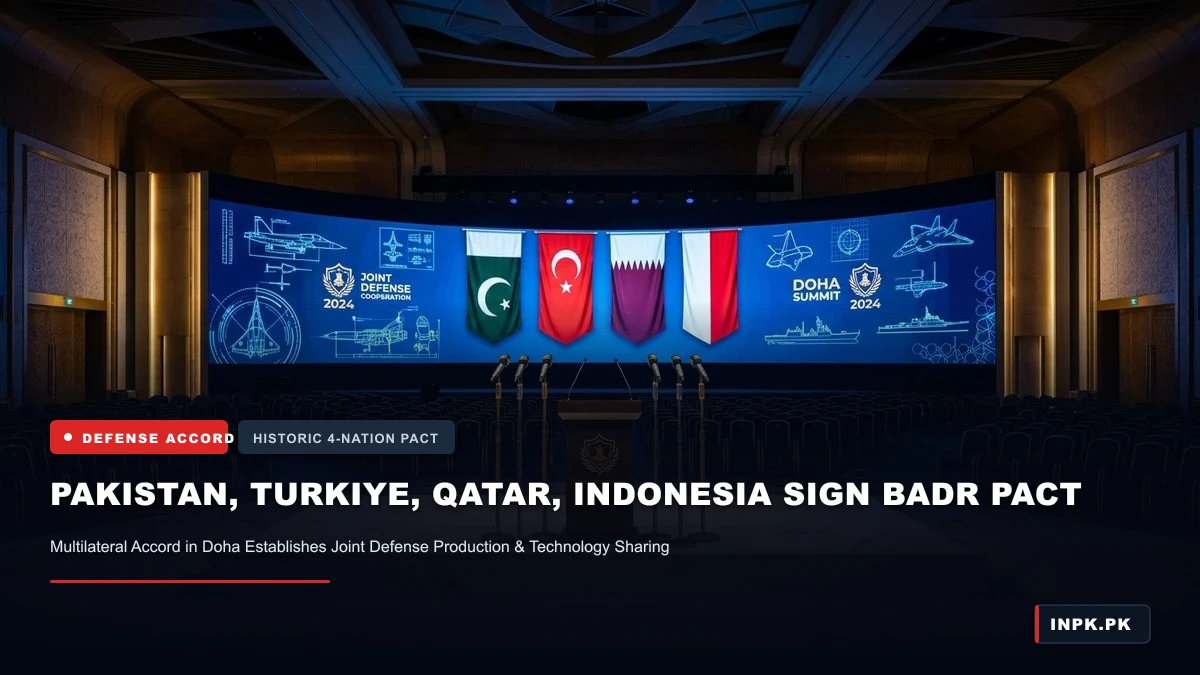
Marking a transformative realignment in regional military collaboration and defense-industrial integration, Pakistan, Turkiye, Qatar, and Indonesia have formally signed a multilateral defense cooperation agreement known as the Badr Memorandum of Understanding (MoU) during high-level ministerial consultations convened in Doha, Qatar. The historic quadrilateral accord establishes a permanent institutional framework designed to pool industrial capabilities, accelerate joint defense manufacturing, and eliminate technological dependencies on traditional Western weapons suppliers.
The landmark treaty was endorsed by high-ranking defense leadership representing all four sovereign states, including Pakistan Federal Minister for Defense Khawaja Muhammad Asif, Turkish National Defense Minister Yasar Guler, Qatari Deputy Prime Minister and Minister of State for Defense Affairs Sheikh Saoud bin Abdulrahman bin Hassan Al Thani, and Indonesian Deputy Minister of Defense Marshal Yusuf Jauhari. Haluk Gorgun, President of the Turkish Defense Industry Agency (SSB), alongside senior procurement chiefs and aerospace commanders, participated in the bilateral and multilateral signing sessions.
Transitioning from Buyer-Seller Dynamics to Co-Production
Unlike conventional bilateral procurement agreements or collective defense treaties, the Badr accord is engineered specifically around defense-industrial co-development and localized hardware manufacturing. Defense analysts note that the initiative marks an unprecedented departure from transactional buyer-seller arrangements, creating a unified industrial pipeline capable of fulfilling domestic military requirements while exporting modern defense hardware to allied states across Asia, the Middle East, and Africa.
Under the operational terms ratified in Doha, the four partner nations will synchronize joint development programs across aerospace systems, naval warfare platforms, armored tactical vehicles, air defense sensors, and unmanned combat aerial vehicles (UCAVs). The initiative leverages Turkiye advanced electronic warfare and aerospace manufacturing base, Pakistan proven operational expertise in aerial engineering and missile ballistics, Qatar substantial financial resources and strategic logistics, and Indonesia expansive maritime shipbuilding facilities.
Strategic Symbolism of the Badr Alliance
Officials familiar with the treaty negotiations confirmed that the designation Badr, meaning full moon, was deliberately selected to symbolize how the complementary sovereign strengths of the four participating powers converge into a cohesive, complete capability. The accord directly follows earlier regional arrangements, including the Makkah Joint Defense initiative, positioning the signatory nations as influential middle powers capable of maintaining strategic autonomy amid shifting global security dynamics.
The defense ministry delegations underscored that ongoing global supply chain disruptions and political conditionalities imposed by traditional weapon manufacturers underscored the urgency of establishing an indigenous defense industrial base. The Badr framework institutionalizes mutual technology transfers, reciprocal intellectual property protections, and integrated manufacturing lines, ensuring uninterrupted supply of ammunition, spare parts, and advanced guidance assemblies during geopolitical crises.
Joint R&D Labs and Technical Military Academies
To implement the mandate, the Badr pact establishes specialized joint research and development laboratories located across Islamabad, Ankara, Doha, and Jakarta. These facilities will focus on artificial intelligence applications in autonomous target acquisition, quantum-resistant military communications, and hypersonic aerodynamic modeling. In parallel, reciprocal officer training programs and technical engineer exchanges will commence across military academies and defense research organizations to build a shared cadre of specialized technical specialists.
Addressing delegates following the ceremonial signing, Defense Minister Khawaja Asif emphasized that Pakistan commitment to the Badr accord reflects its broader doctrine of regional stability through credible technological deterrence. Asif affirmed that the multi-nation collaboration does not target any third state, but rather provides a resilient pillar of technological self-sufficiency and sovereign security for developing nations. For continuous geopolitical analysis and defense sector developments, examine our national news archives and follow detailed defense policy reporting.