
By Zubair
Lahore
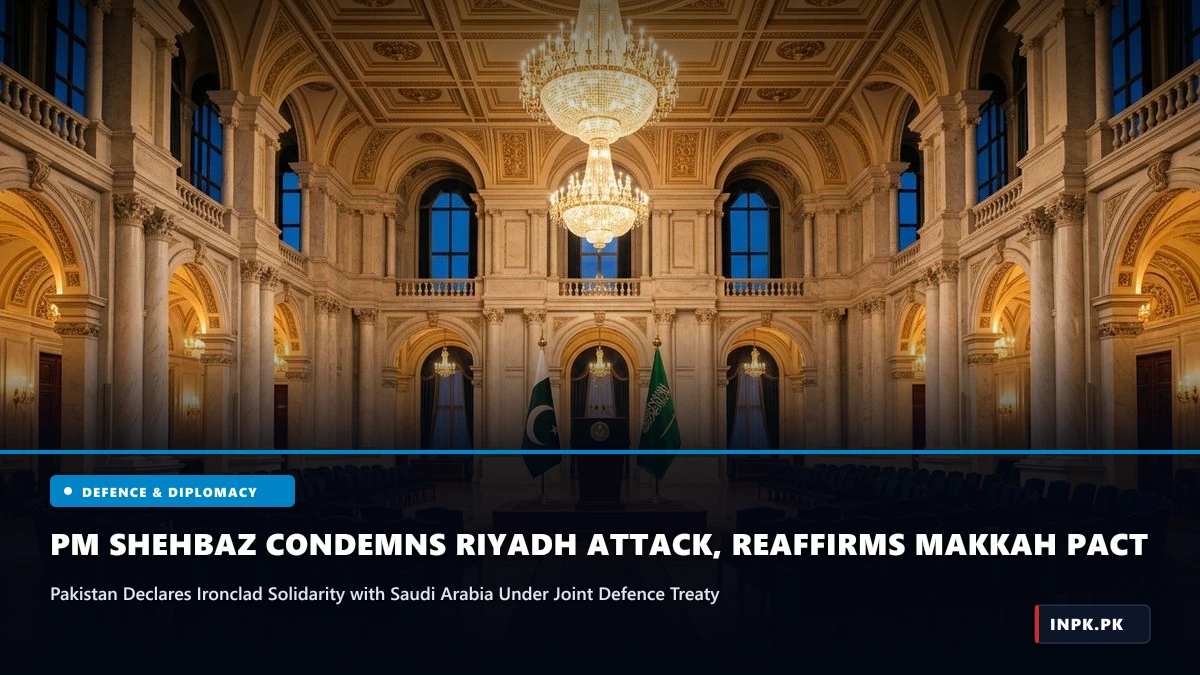
Prime Minister Shehbaz Sharif has issued a forceful condemnation of the recent drone and missile strikes targeting King Khalid International Airport and civilian infrastructure in Riyadh, reiterating that Pakistan stands shoulder-to-shoulder with the Kingdom of Saudi Arabia under the binding mutual assistance protocols of the historic Makkah Joint Defence Agreement. The statement, issued following high-level diplomatic and national security consultations in Islamabad, underscores Pakistan's unwavering pledge to safeguard the territorial integrity and sovereignty of the fraternal Gulf kingdom.
The Ministry of Foreign Affairs simultaneously conveyed Islamabad's deepest solidarity with the Saudi leadership, emphasizing that unlawful aerial attacks against civilian aviation hubs violate international humanitarian law and present a grave provocation to broader Middle Eastern maritime and regional stability.
Strategic Framework of the Makkah Joint Defence Pact
The condemnation comes on the heels of the formal operationalization of the trilateral Makkah Joint Defence Agreement, concluded between Pakistan, Saudi Arabia, and Turkiye. Under the treaty's core articles, any hostile military aggression or non-state threat directed against the sovereignty or vital installations of any signatory state is deemed a shared threat triggering synchronized defensive consultations, operational coordination, and deterrence measures.
Official defense sources in Islamabad indicated that Pakistani military attachés and air defense liaisons stationed in Riyadh are coordinating closely with the Royal Saudi Air Defense Forces, assessing aerial threat vectors and reviewing integrated countermeasures to ensure uninterrupted protection for vital civic and energy nodes.
Diplomatic Mobilization and Collective Deterrence
In his address, Prime Minister Shehbaz Sharif noted that the security of the Holy Mosques and the territorial sanctuary of Saudi Arabia represent permanent, sacred national priorities for the state and people of Pakistan. The Prime Minister called upon the international community and the United Nations Security Council to adopt immediate punitive measures against destabilizing non-state militias and their regional benefactors seeking to inflame regional conflict.
Foreign Minister and regional security analysts emphasized that the rapid consolidation of the Makkah treaty architecture represents a pivotal pillar of deterrence, designed specifically to shield vital Gulf trade lanes and air corridors from missile blackmail and asymmetric drone warfare.
Consolidation of Bilateral Security Cooperation
Defense cooperation between Islamabad and Riyadh encompasses joint air combat exercises, counterterrorism training, maritime security sweeps in the Arabian Sea, and long-standing advisory missions. Military officials confirmed that Pakistan's armed forces remain primed to fulfill every agreed obligation to reinforce Saudi civil defense architectures whenever requested.
As geopolitical realignments accelerate across West Asia, Islamabad's unequivocal stance reaffirms its central role as a trusted security anchor for the Islamic world. For ongoing institutional reporting on global diplomacy, foreign affairs, and strategic alliances, follow INPK News and explore geopolitical policy briefings at INPK Politics.