
Updated: August 9, 2026
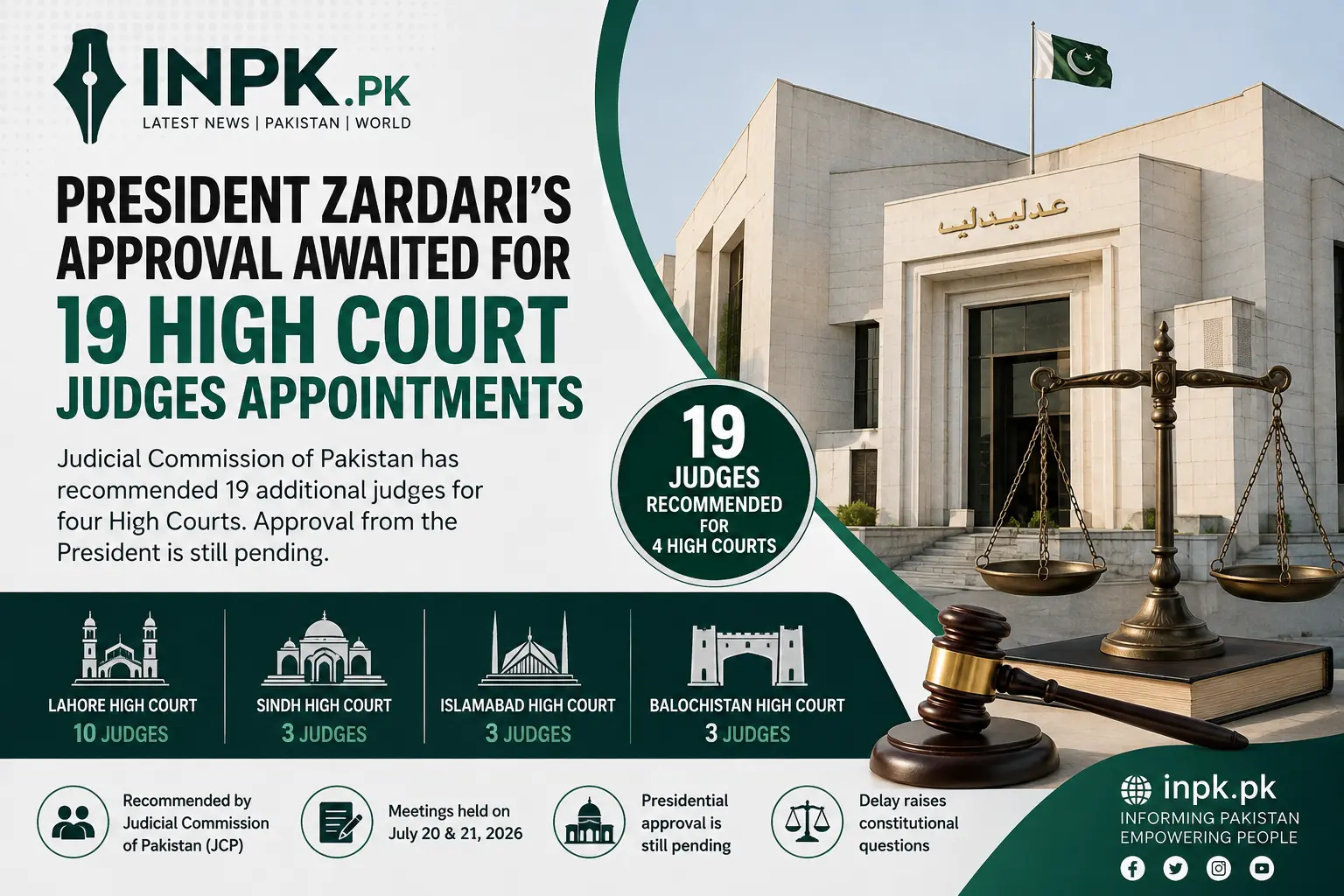
The appointment of 19 additional judges to four High Courts of Pakistan has become an important constitutional and judicial issue after recommendations approved by the Judicial Commission of Pakistan (JCP) awaited presidential approval.
The Judicial Commission, headed by Chief Justice of Pakistan Justice Yahya Afridi, recommended the 19 new appointments during meetings held on July 20 and July 21, 2026. The nominees are for the Lahore High Court, Sindh High Court, Islamabad High Court and Balochistan High Court.
The latest publicly verified reports located during an August 9 review showed that the summary had remained pending with President Asif Ali Zardari through the end of July. No later official announcement from the Presidency confirming approval of these 19 appointments was found during the review.
This means the central issue is not whether the Judicial Commission selected the nominees — that stage has already taken place — but the completion of the constitutional appointment process.
How many judges did the Judicial Commission recommend?
The 19 proposed new additional judges are distributed among four High Courts:
- Lahore High Court: 10
- Sindh High Court: 3
- Islamabad High Court: 3
- Balochistan High Court: 3
The JCP made the Sindh and Islamabad High Court recommendations on July 20 and considered the Lahore and Balochistan High Court appointments on July 21.
It is important to distinguish these 19 new appointments from several other decisions taken by the JCP during the same meetings, including recommendations concerning confirmation or extension of serving additional judges.
10 nominees for Lahore High Court
According to the official Press Information Department record of the JCP's July 21 meeting, the Commission recommended the following ten people for appointment as additional judges of the Lahore High Court:
- Amir Ajam Malik
- Asad Ali Bajwa
- Barrister Muhammad Usman Ghani Rashid Cheema
- Ghulam Sarwar Nihang
- Khalid Ibn-i-Aziz
- Muhammad Ajmal Khan Zahid
- Muhammad Amjad Pervaiz
- Munawar Iqbal Duggal
- Shiren Imran
- Syed Farhad Ali
The Commission also separately recommended the confirmation of Additional Judge Justice Tariq Mahmood Bajwa as a judge of the Lahore High Court.
Three nominees for Sindh High Court
For the Sindh High Court, the JCP recommended:
- Muhammad Humayon Khan
- Suresh Kumar
- Dr Shah Nawaz Memon
Two other available positions were left unfilled because the nominees under consideration did not obtain the required majority of the Commission's total membership.
The JCP also dealt separately with the status of existing Sindh High Court judges and the tenure of its constitutional benches.
Three nominees for Islamabad High Court
The Judicial Commission recommended three additional judges for the Islamabad High Court:
- Ayyaz Shaukat
- Shahrukh Arjumand
- Umair Majeed Malik
Ayyaz Shaukat and Umair Majeed Malik were nominated from the legal profession, while Shahrukh Arjumand was serving as a district and sessions judge at the time of the recommendation.
Three nominees for Balochistan High Court
The JCP recommended the following three nominees as additional judges of the Balochistan High Court:
- Allah Dad Roshan
- Muhammad Rauf Atta
- Abdul Qayyum Lehri
Five Balochistan High Court vacancies were under consideration, but the Commission filled only three of them, leaving two positions vacant.
Why is President Zardari’s approval important?
Pakistan's constitutional framework gives the Judicial Commission of Pakistan a central role in the appointment of superior court judges.
Article 175A establishes the Judicial Commission and provides the constitutional framework governing appointments to the superior judiciary.
After the JCP completed its recommendations, reporting on the current process said the nominations were forwarded through the executive process, with the prime minister advising the president regarding the appointments.
Until the appointment process is completed, the selected nominees cannot simply assume office on the strength of the JCP recommendation alone.
Why has approval been delayed?
This is where confirmed facts need to be separated from political reporting.
It is confirmed that the JCP completed the relevant recommendations on July 20 and 21 and that, by July 28-30, presidential approval had not been issued. An oath-taking ceremony that had reportedly been expected for July 27 was consequently postponed.
Different explanations have subsequently appeared in media reports.
The Express Tribune reported that the PPP was unhappy because its preferred candidates had not secured JCP approval. The newspaper cited government sources in reporting tensions over the delay.
Separately, Dawn reported that sources in the Presidency had raised reservations concerning some nominees. The President's spokesperson, Murtaza Solangi, was quoted as saying that the appointments would proceed “in due time.”
However, no publicly verified statement from President Zardari has established PPP dissatisfaction or any other political consideration as the official reason for withholding approval.
For that reason, claims that the appointments have been blocked specifically for political reasons should be treated as reported interpretations rather than established fact.
Article 48 becomes part of the debate
The delay has also generated a constitutional discussion around Article 48 of the Constitution, which generally deals with the president acting on the advice of the Cabinet or prime minister.
Reports said government legal officials were considering constitutional options if the delay continued. Sources associated with the Presidency, meanwhile, argued that the constitutional position should not be interpreted as allowing the Presidency to be bypassed and pointed to provisions concerning presidential discretion.
Legal experts cited in the same reporting took a different view, maintaining that previous superior-court rulings have held that the president does not exercise independent discretion in appointments to the superior judiciary when constitutionally required advice has been tendered.
The matter therefore involves more than an administrative delay; it has also raised questions about the respective constitutional roles of the JCP, prime minister and president.
Delay affected court functioning
The issue has practical consequences for litigants as well.
Dawn reported on July 30 that the Lahore High Court's Rawalpindi bench was left without a sitting judge during that period, while judicial work at other regional registries was also affected amid shortages and summer leave arrangements.
The ten newly recommended LHC judges had been expected to help ease the pressure, but their appointments could not take effect without completion of the formal process.
Pakistan's courts already face significant workloads, making vacancies more than an institutional or political issue. Fewer available judges can affect hearing schedules, bail matters, constitutional petitions and ordinary civil and criminal cases.
What happens next?
The immediate next development to watch is a formal decision from the Presidency.
If President Zardari approves the appointments, the required notifications and oath-taking process can move ahead, allowing the 19 nominees to assume office as additional judges of their respective High Courts.
If the delay continues, debate over the constitutional mechanism available to the federal government may intensify.
Any authoritative update should ultimately come through an official notification, the Presidency, the federal government or another competent constitutional authority.
Until such an announcement is issued, reports about political motives or a possible constitutional confrontation should not be treated as equivalent to an official decision.
Why the 19 High Court judges appointments matter
The controversy is significant for three reasons.
First, it concerns 19 judicial positions across four important High Courts, giving the matter a direct impact on Pakistan's justice system.
Second, it raises an institutional question over how quickly JCP recommendations should move through the remaining constitutional appointment process.
Third, the delay has arrived at a time when judicial vacancies and case workloads continue to affect access to justice.
The JCP's recommendations themselves are documented. The unresolved question is when the appointments will formally take effect — and whether the present delay will be resolved administratively or develop into a larger constitutional dispute.
Frequently Asked Questions
How many High Court judges are awaiting appointment?
The Judicial Commission recommended 19 new additional judges for four High Courts: 10 for the Lahore High Court and three each for the Sindh, Islamabad and Balochistan High Courts.
When did the JCP approve the 19 nominees?
The relevant Judicial Commission meetings were held on July 20 and July 21, 2026.
Has President Zardari rejected the judges?
There is no verified public announcement showing that President Asif Ali Zardari has formally rejected the 19 nominees. The latest verified reporting described the approval as pending.
Why have the appointments been delayed?
Media reports have offered different explanations, including reported reservations over nominees and political dissatisfaction with the JCP selections. However, no official presidential statement has confirmed a specific political reason for the delay.
Which High Courts are affected?
The appointments involve the Lahore High Court, Sindh High Court, Islamabad High Court and Balochistan High Court.
What happens after presidential approval?
Once the constitutional appointment process is completed, official notifications can be issued and the newly appointed additional judges can take their oaths and begin judicial duties.