
By Zubair
Lahore
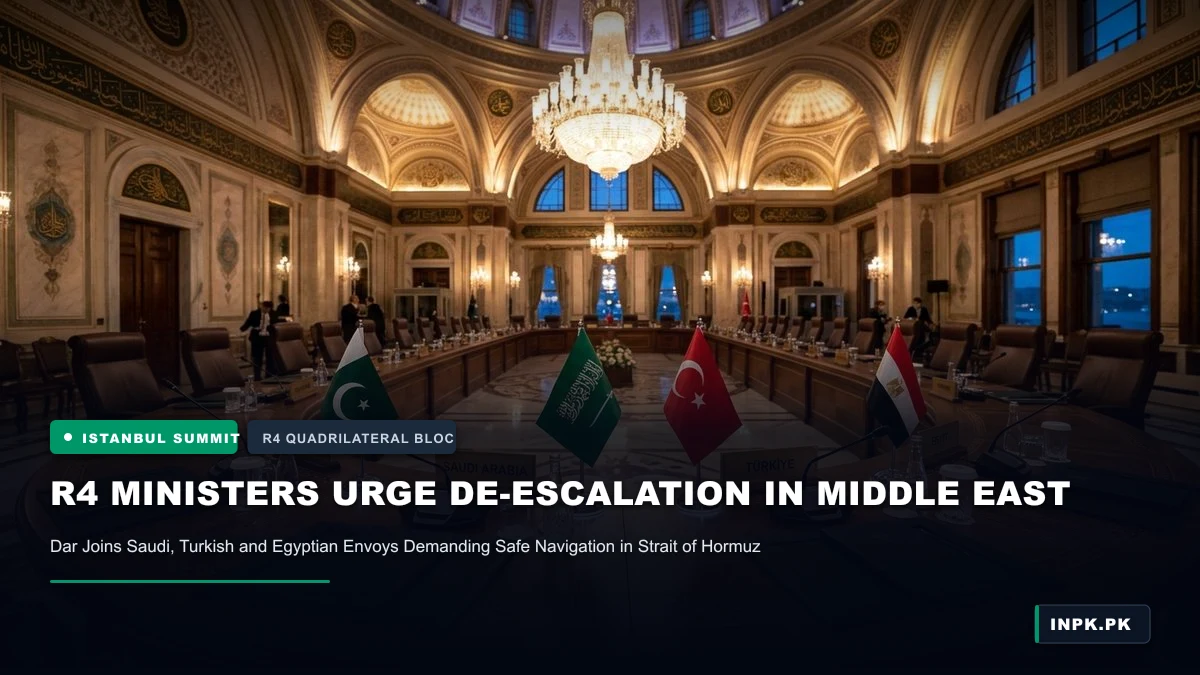
Amid intensifying regional military escalation and rising threats to international maritime commercial lanes, foreign ministers from Pakistan, Saudi Arabia, Turkiye, and Egypt convened in Istanbul for the landmark ministerial summit of the newly formalized R4 diplomatic group. Deputy Prime Minister and Minister for Foreign Affairs Senator Mohammad Ishaq Dar represented Pakistan at the high-level consultations alongside Turkish Foreign Minister Hakan Fidan, Saudi Foreign Minister Prince Faisal bin Farhan Al Saud, and Egyptian Foreign Minister Badr Abdelatty, with senior diplomatic delegations from the United Kingdom, France, Germany, and Italy participating in extended consultative sessions.
The ministerial summit concluded with a comprehensive joint declaration demanding immediate diplomatic de-escalation across the Middle East. The four pivotal regional powers emphasized that ongoing hostilities risk igniting a broader trans-regional conflict capable of inflicting severe humanitarian and economic devastation upon developing nations across Asia and Africa.
Demand for Unhindered Maritime Navigation in the Strait of Hormuz
A primary strategic outcome of the Istanbul deliberations was the collective position adopted on international maritime security, specifically regarding the critical choke point of the Strait of Hormuz. With global benchmark Brent crude surging past multi-month highs amidst naval friction and missile interceptions, the R4 ministers explicitly rejected any unilateral efforts to obstruct or threaten commercial shipping corridors.
The joint statement affirmed that safe, predictable, and unrestricted navigation through the Strait of Hormuz and adjacent Gulf waters is essential for safeguarding international energy supplies, petrochemical flows, and agricultural fertilizer distribution. The ministers underscored that disruptions to maritime corridors jeopardize global food security and inflict disproportionate inflationary shocks on emerging economies, calling upon all state and non-state actors to uphold international maritime conventions.
Endorsement of the Islamabad MoU and Multilateral Mediation
The ministers formally endorsed the cooperative diplomatic framework established under the Islamabad Memorandum of Understanding, reiterating that lasting stability cannot be achieved through unilateral military action or coercive measures. The R4 alliance articulated support for institutional dialogue mechanisms that guarantee sovereign territorial integrity, protection of civil infrastructure, and compliance with United Nations Security Council resolutions.
During multilateral working sessions with European foreign ministers, the R4 delegation stressed the necessity of a coordinated humanitarian response to address displacement crises and protect civilian populations caught in conflict theaters. The ministerial council agreed to establish a continuous diplomatic liaison group between Islamabad, Riyadh, Ankara, and Cairo to synchronize multilateral initiatives at the United Nations General Assembly and regional security forums.
Pakistan Strategic Role in Regional De-escalation
In his address to the ministerial assembly, Deputy Prime Minister Ishaq Dar underscored Pakistan's proactive diplomatic engagement aimed at bridging divides between regional stakeholders. Dar noted that as a nation maintaining close fraternal partnerships across the Gulf and broader Muslim world, Pakistan views regional stability as indivisible from its own economic security and sovereign development priorities.
The Deputy Prime Minister reiterated Islamabad's steadfast support for the fundamental rights of oppressed populations and called on global powers to demonstrate equitable adherence to international legal norms. The Istanbul consultations reflect Pakistan's expanding multilateral diplomacy, positioning the country as an active bridge-builder fostering de-escalation in critical geopolitical arenas. For continuous analysis of international affairs and foreign ministry briefings, visit our national news archives and explore comprehensive diplomatic and geopolitical coverage.