
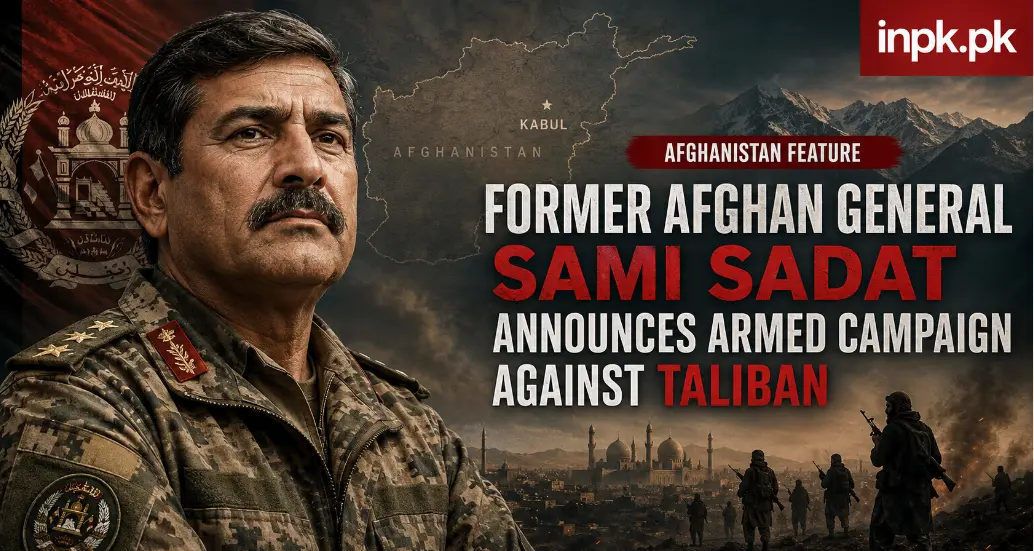
Former Afghan army commander Lieutenant General Sami Sadat has announced that the Afghanistan United Front is moving from political opposition into armed operations against Taliban personnel and positions, according to an account circulating widely on X.
The development has drawn attention across the region because Sadat served as a senior commander in Afghanistan's former security forces before the Taliban returned to power in August 2021. The announcement presents the Afghanistan United Front, commonly abbreviated as AUF, as both an armed and political opposition movement.
What has been announced?
An X trending summary published on 2 August 2026 says the AUF, chaired by Sadat, has shifted from political activity to operations targeting Taliban members and positions. Posts included in the trend describe the move as the opening of a new combat front.
The trend summary says the group intends to combine operations inside Afghanistan with diplomatic efforts abroad. It identifies restoration of Afghanistan's pre-Taliban constitutional order as one of the movement's stated political objectives.
These statements represent the AUF's position and claims reported through social media. At the time this draft was prepared, full operational details and the scale of the group's presence inside Afghanistan had not been independently established.
Reported Kandahar-Spin Boldak highway attack
Accounts associated with the announcement claim that AUF fighters carried out an attack on 30 July along the Kandahar-Spin Boldak highway. Social-media reports said a Taliban member was killed in the incident.
The precise location, circumstances and casualty figure require independent verification. No detailed evidence establishing the group's account was available in the trend material, and claims made by parties to an armed conflict should be treated cautiously until corroborated by multiple reliable sources.
The Kandahar-Spin Boldak route is strategically important because it links Kandahar with the border crossing into Pakistan. Any sustained militant activity along the corridor would carry security and trade implications, but a single reported attack does not by itself demonstrate that the AUF has established a durable operational presence there.
Who is Sami Sadat?
Sami Sadat is a former lieutenant general in the Afghan National Army. He served in senior command roles during the final years of the internationally backed Afghan republic and became a prominent public critic of the Taliban after the collapse of the former government in 2021.
Sadat later became associated with efforts to organize former officials, military personnel and political figures opposed to Taliban rule. The Afghanistan United Front was formed in the United States in 2023, according to the X trend summary, and has until now been known mainly for political advocacy and outreach.
Leading an armed movement from outside Afghanistan creates substantial difficulties. Commanders must establish reliable networks inside the country, maintain secure communications, obtain resources and prevent infiltration while also trying to win political support. The AUF's ability to overcome those obstacles remains unclear.
A fragmented anti-Taliban landscape
The Afghanistan United Front is not the only organization challenging Taliban rule. Other armed groups have claimed attacks in northern and northeastern provinces, while political opposition figures abroad have tried to build international support for a more inclusive Afghan government.
These movements differ in leadership, regional influence and political priorities. Limited coordination has long been one of the biggest constraints on opposition to the Taliban. Competition for recognition and resources can make it difficult for separate groups to develop a unified political or military strategy.
The Taliban, meanwhile, controls the state apparatus and most of Afghanistan's territory. It has repeatedly said that security has improved under its government and has described armed opponents as criminal or destabilizing groups. A verified Taliban response specifically addressing Sadat's latest announcement was not identified in the material reviewed for this draft.
Why the announcement matters for Pakistan
Developments in southern Afghanistan are closely watched in Pakistan because of the long shared border, cross-border trade and continuing concerns about militant violence. Spin Boldak lies opposite Chaman in Balochistan, one of the principal crossing points between the two countries.
Any expansion of armed activity near border routes could affect travel, commercial traffic and local security calculations. However, it is too early to determine whether the AUF announcement signals a sustained campaign or a limited effort to establish the group's profile.
Pakistan has faced its own tensions with the Taliban authorities in Kabul, particularly over the presence and activities of Tehreek-e-Taliban Pakistan. That dispute is separate from the AUF announcement, and no evidence in the reviewed material establishes Pakistani involvement in Sadat's initiative.
What happens next?
The credibility of the AUF's announcement will depend on whether it can demonstrate a continuing presence inside Afghanistan, document its operational claims and develop a clear political program. Its relationship with other anti-Taliban groups will also be important.
Independent reporting from the areas where attacks are claimed will be essential. Restrictions on media activity and access inside Afghanistan make rapid verification difficult, especially when incidents occur in remote or heavily controlled locations.
For now, the announcement is best understood as a potentially significant statement of intent by a former senior Afghan commander. Whether it changes the balance on the ground remains uncertain.