
By Zubair
Lahore
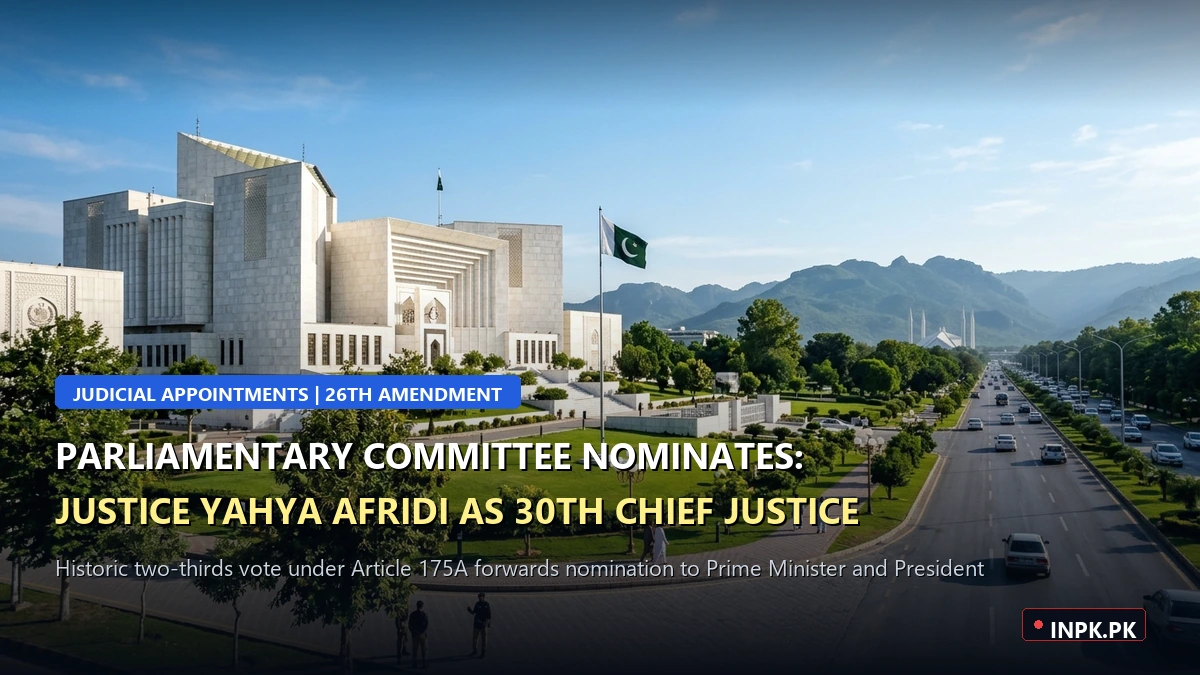
ISLAMABAD — In an unprecedented milestone for Pakistan's legal and parliamentary landscape, a newly constituted 12-member Special Parliamentary Committee has voted by a two-thirds majority to nominate Supreme Court Justice Yahya Afridi as the 30th Chief Justice of Pakistan. The decision, finalized during an in-camera session at Parliament House late Tuesday night, represents the first operational implementation of the judicial appointment framework enacted under the 26th Constitutional Amendment.
The committee's recommendation was formally forwarded by National Assembly Speaker Sardar Ayaz Sadiq to Prime Minister Shehbaz Sharif, who endorsed the summary and transmitted it to President Asif Ali Zardari for formal approval and official gazette notification. Justice Afridi, currently the third most senior jurist on the Supreme Court bench, is scheduled to take the constitutional oath of office on October 26, succeeding outgoing Chief Justice Qazi Faez Isa upon his superannuation.
Two-Thirds Majority Vote in In-Camera Parliamentary Session
The parliamentary committee convened under the newly amended Article 175A of the Constitution of Pakistan, which empowers a bicameral legislative body to select the next Chief Justice from a panel consisting of the three most senior judges of the apex court. The judicial panel submitted by the Ministry of Law and Justice comprised Justice Syed Mansoor Ali Shah, Justice Munib Akhtar, and Justice Yahya Afridi.
Of the 12 committee members, nine lawmakers attended the decisive session, including representatives from the Pakistan Muslim League-Nawaz (PML-N), the Pakistan Peoples Party (PPP), the Muttahida Qaumi Movement-Pakistan (MQM-P), and Jamiat Ulema-e-Islam-Fazl (JUI-F). Three opposition members representing Pakistan Tehreek-e-Insaf (PTI) and the Sunni Ittehad Council boycotted proceedings. Following extensive deliberations, eight of the nine attending members cast ballots in favor of Justice Afridi, surpassing the constitutionally mandated two-thirds threshold of the total membership.
Constitutional Reforms and New Tenure Framework
Under the landmark provisions of the 26th Constitutional Amendment passed earlier this week, the traditional principle of automatic seniority for the office of Chief Justice has been replaced by a structured parliamentary selection mechanism. Additionally, the amendment establishes a fixed three-year tenure for the Chief Justice of Pakistan, subject to the constitutional retirement age limit of 65 years.
Law Minister Azam Nazeer Tarar emphasized that the legislative reform aims to restore institutional equilibrium, enhance public accountability in judicial administration, and clear historic case backlogs through dedicated constitutional benches. Senior government leaders commended the cross-party consensus, noting that the peaceful transition establishes legal certainty for the superior judiciary.
Distinguished Judicial Career of Justice Yahya Afridi
Born on January 23, 1965, in Dera Ismail Khan, Justice Yahya Afridi received his early education at Aitchison College Lahore and Government College Lahore before obtaining his Bachelor of Laws (LLB) from Punjab University Law College. He subsequently completed his Master of Laws (LLM) at Jesus College, University of Cambridge, as a Commonwealth Scholar.
Justice Afridi was enrolled as an advocate of the High Court in 1990 and as an advocate of the Supreme Court in 2004. He served as an Additional Judge of the Peshawar High Court in 2010 and was confirmed as a permanent judge in 2012. In December 2016, he made history by becoming the first jurist from the tribal districts to serve as Chief Justice of the Peshawar High Court. Elevated to the Supreme Court of Pakistan in June 2018, Justice Afridi has authored authoritative judgments spanning constitutional law, commercial arbitration, tax jurisprudence, and fundamental human rights.
Stay informed on institutional reforms, judicial appointments, and supreme court proceedings with comprehensive coverage on INPK national news and in-depth legislative analysis at INPK political developments.