
By Web Desk
Washington
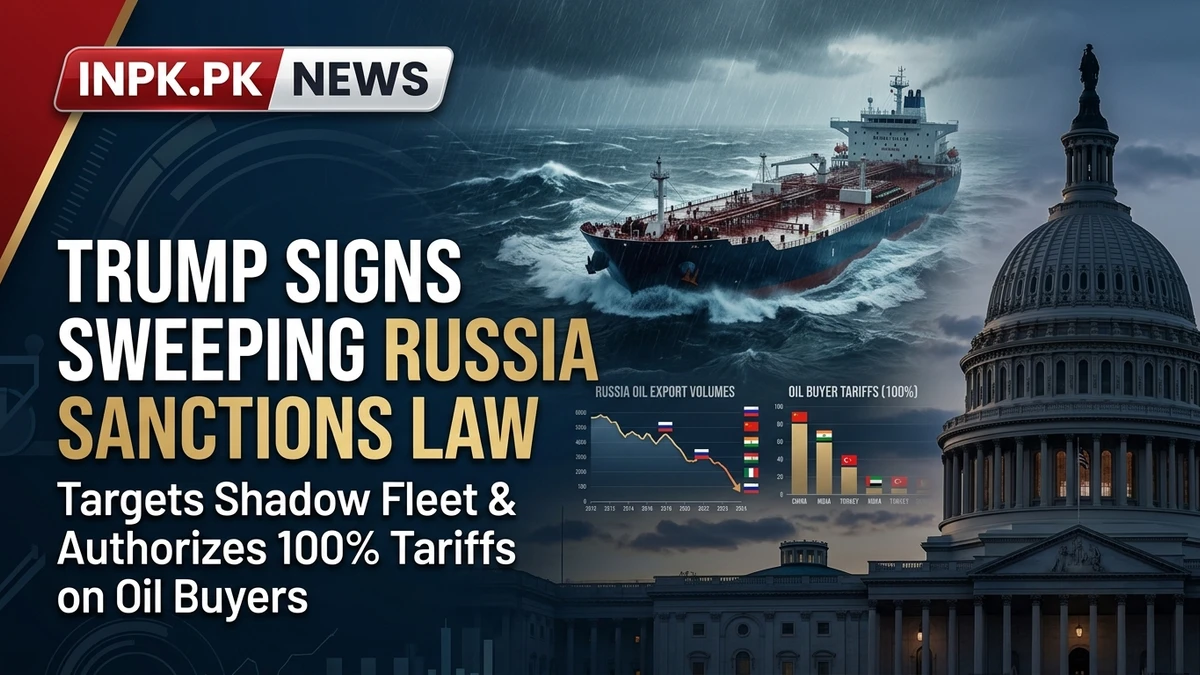
United States President Donald Trump has officially signed into law a sweeping bipartisan sanctions package aimed at delivering a crippling economic blow to the Russian Federation, aggressively targeting Moscow's clandestine maritime "shadow fleet" and granting the White House unprecedented statutory authority to impose retaliatory tariffs of up to 100% on major foreign purchasers of Russian crude oil and natural gas.
The landmark legislation, formally titled the Lindsey O. Graham Sanctioning Russia and Iran Act of 2026 (H.R. 5334), passed both chambers of Congress with overwhelming veto-proof majorities earlier this week. Named in honor of the late Republican Senator Lindsey Graham, who co-authored the measure alongside Democratic Senator Richard Blumenthal before his passing earlier this year, the act represents the most punitive escalation in American economic statecraft since the onset of the conflict in Ukraine.
Aggressive Crackdown on the Maritime 'Shadow Fleet'
At the core of the new sanctions framework is an uncompromising offensive against Russia's sprawling "shadow fleet"—an opaque network comprising hundreds of aging, flag-of-convenience oil tankers and unregistered maritime operators established to bypass the Group of Seven (G7) price caps and maritime insurance restrictions.
Under the statutory mandates of the new law, the U.S. Department of the Treasury and the Department of State are required to impose comprehensive blocking sanctions, asset freezes, and port entry bans on any vessel, corporate entity, marine insurer, or bunkering service involved in transporting Russian crude above Western-designated thresholds. The legislation also introduces secondary sanctions targeting sovereign maritime registries and flag states that facilitate illicit ship-to-ship oil transfers in international waters.
Secondary Tariff Authority Targeting Major Energy Buyers
In what analysts describe as the law's most consequential and geopolitically sensitive mechanism, Section 4 of the act authorizes the President to execute discretionary tariffs of up to 100% on imported goods originating from countries that continue large-scale commercial purchases of Russian hydrocarbons. The provision is explicitly designed to disrupt the primary revenue streams sustaining the Kremlin's defense budget, placing top importers—most notably China, India, and Turkey—under acute economic scrutiny.
While the White House retains waiver authority under national security provisions, administration officials signaled that the tariff hammer will be leveraged as diplomatic leverage to force third-party nations to curtail Russian energy imports and transition to alternative suppliers. Western market analysts warn that the aggressive tariff mechanisms could introduce renewed volatility into global benchmark crude pricing and complicate ongoing trade negotiations with Beijing and New Delhi.
Broader Defense and Financial Sector Interdictions
Beyond maritime transport and energy exports, the act expands statutory restrictions across Russia's domestic banking system, sovereign wealth entities, and military-industrial manufacturing complexes. It extends strict export controls on dual-use microelectronics, advanced aerospace components, and industrial machinery, while simultaneously tightening sanctions against Iran's ballistic missile and drone manufacturing sectors for their ongoing military cooperation with Moscow.
Congressional leadership praised the bipartisan signing, characterizing the measure as a decisive signal of American resolve. "This law ensures that those financing aggression and evading international law face severe, unavoidable economic consequences," Senate leaders remarked following the signing ceremony.
Readers can monitor evolving global trade developments, energy market reactions, and international diplomatic responses through continuous updates on INPK world news coverage.