
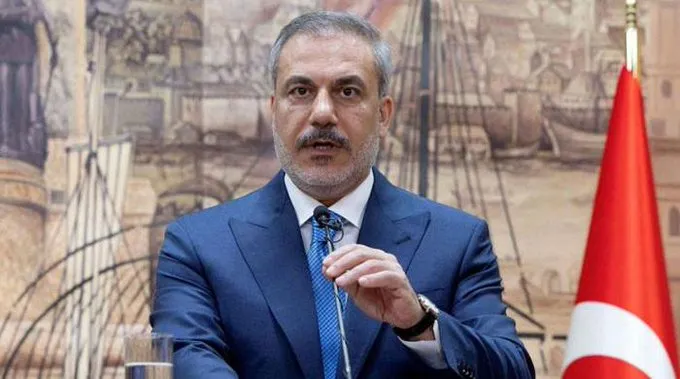
Türkiye Clarifies Scope of Pakistan-Saudi Arabia-Türkiye Defence Pact
Türkiye has clarified that Iran or any other country is not a target of the Pakistan-Saudi Arabia-Türkiye defence pact, saying the newly signed agreement is defensive in nature and would become relevant in the event of an attack on one of its member states.
Turkish Foreign Minister Hakan Fidan said the agreement between Pakistan, Saudi Arabia and Türkiye was not created to target Iran and that no country was being designated as an adversary unless it carried out an attack against a member of the pact.
The clarification comes a day after the three countries signed the Makkah Joint Defence Agreement, establishing a collective-defence commitment under which an armed attack on one of the three states would be regarded as an attack on all of them.
Fidan's remarks are significant because the agreement has attracted intense regional attention, particularly over its possible implications for Iran amid continuing security tensions in the Middle East.
Hakan Fidan Says Agreement Does Not Target Iran
Speaking about the scope of the agreement, the Turkish foreign minister rejected the suggestion that the new trilateral framework had been created specifically against Iran.
According to his explanation, the agreement does not identify Iran — or any other country — as a predetermined target. Its central purpose is collective defence if one of the participating states comes under attack.
That position is consistent with statements issued by Turkish officials immediately after the agreement was signed.
President Recep Tayyip Erdoğan said the Makkah Joint Defence Agreement targets no country and is based on the right of self-defence recognised under Article 51 of the United Nations Charter. A Turkish government official separately described the pact as purely defensive and not directed against any specific actor.
This distinction is central to Ankara's public explanation of the agreement: the three countries are establishing a mechanism for mutual defence rather than declaring another state an enemy.
Defence Pact Compared With NATO Article 5
Fidan also said the collective-defence mechanism in the new agreement is technically similar to NATO's Article 5 principle, under which an attack on one member is treated as an attack on the alliance as a whole.
The comparison relates to the basic principle of collective defence rather than suggesting that the new arrangement and NATO are identical in every institutional or legal respect.
The Makkah agreement states that an armed attack against Pakistan, Saudi Arabia or Türkiye would be regarded as an attack against all three countries.
This provision is among the most consequential elements of the deal because it formalises a mutual security commitment between three countries with substantial military, economic and geopolitical influence.
Türkiye is already a member of NATO, Pakistan is a nuclear-armed state with extensive military experience, while Saudi Arabia is a major Gulf power with significant economic and strategic influence.
Foreign Ministers' Committee and General Secretariat Planned
The new defence framework is also expected to develop its own institutional structure.
Fidan said a committee of ministers would be created as part of the arrangement, alongside a general secretariat based in Saudi Arabia. He compared these institutional elements with structures used within NATO.
Geo News Urdu also reported the Turkish foreign minister as saying that a foreign ministers' committee and a general secretariat would be established under the defence arrangement.
The creation of permanent mechanisms could allow the three governments to coordinate defence policy, consultations and implementation more regularly rather than limiting cooperation to occasional bilateral meetings.
However, detailed procedures governing how the institutions will operate have not yet been fully made public.
What Does the Makkah Joint Defence Agreement Say?
Pakistan, Saudi Arabia and Türkiye signed the Makkah Joint Defence Agreement on August 7, 2026, during a summit in Makkah.
The agreement was signed by Prime Minister Shehbaz Sharif, Saudi Crown Prince and Prime Minister Mohammed bin Salman, and Turkish President Recep Tayyip Erdoğan.
According to the publicly announced terms, the pact is intended to strengthen collective deterrence and expand defence cooperation among the three states.
Its core provision states that an armed attack on any one of the three participating countries will be regarded as an attack against all of them. The agreement also provides for broader defence cooperation across multiple areas.
Turkish officials have repeatedly stressed that this commitment applies to defence against aggression rather than establishing an offensive alliance.
Why Iran Became a Major Question After the Agreement
Iran has emerged as one of the main subjects of discussion surrounding the pact because the agreement was signed during a period of major regional tensions involving Tehran and Gulf states.
The continuing conflict involving Iran has heightened security concerns across the Gulf and disrupted regional calculations over military deterrence and maritime security. Saudi Arabia has also sought to diversify and strengthen its defence partnerships in response to the changing security environment.
An Iranian parliamentarian, Ebrahim Rezaei, publicly criticised the new agreement and questioned whether it would provide Saudi Arabia with greater security.
Türkiye's latest clarification therefore appears aimed at addressing concerns that the trilateral arrangement should automatically be interpreted as an anti-Iran alliance.
Ankara's stated position is that the agreement is not directed against Tehran and would not target another state unless that state committed aggression against one of the pact's members.
Saudi Arabia Also Rejects Idea of a New Military Bloc
Saudi Arabia has similarly sought to distinguish the agreement from the creation of a sectarian or confrontational military axis.
According to a Saudi statement reported by the Associated Press, the agreement is not intended to establish a military axis or religious and sectarian bloc. Riyadh also said the arrangement does not replace its existing Gulf, Arab or international partnerships.
This position is important because Pakistan, Saudi Arabia and Türkiye maintain their own separate relationships with major international and regional powers.
The three governments have presented the agreement as an additional collective-security framework rather than a mechanism requiring them to abandon existing alliances.
Türkiye Highlights Red Sea Maritime Security
Fidan also linked Türkiye's security interests to the Red Sea, saying the safety of vessels operating there directly affects Turkish interests.
According to the Turkish foreign minister, Türkiye should therefore participate in international efforts led by Saudi Arabia concerning maritime security in the region.
The Red Sea and surrounding waterways are critical international trade routes, connecting the Mediterranean through the Suez Canal with the Arabian Sea and the Indian Ocean.
Disruptions to shipping in these waters can affect energy supplies, commercial transport costs and trade routes connecting Europe, Asia and the Middle East.
The maritime dimension indicates that the new defence cooperation may extend beyond conventional territorial defence and could involve coordination on shared regional security challenges.
Egypt Could Potentially Join the Defence Pact
Another notable element of Fidan's remarks concerned possible expansion of the agreement.
The Turkish foreign minister said Egypt could potentially join the defence arrangement once certain technical issues are resolved.
No final decision on Egyptian membership has been announced.
President Erdoğan had earlier indicated that the agreement was open to other brotherly countries seeking peace, stability and prosperity in the region.
The possibility of additional members could become one of the most closely watched aspects of the agreement, particularly if the three founding countries seek to develop it into a broader regional security structure.
Pakistan, Saudi Arabia and Türkiye Bring Different Defence Strengths
The pact brings together three states with different but potentially complementary strategic capabilities.
Pakistan has a large and experienced military and is the Muslim world's nuclear-armed state. Türkiye possesses NATO's second-largest military and a rapidly expanding domestic defence industry. Saudi Arabia brings substantial financial resources, regional influence and significant investment in military modernisation.
Analysts cited by the Associated Press have suggested that cooperation may focus heavily on diplomacy, defence production and technology transfer rather than automatically resulting in large-scale troop deployments.
The agreement could consequently become important for joint defence projects, military technology, training, operational coordination and broader strategic consultation.
The precise extent of those arrangements will depend on how the pact is implemented.
Collective Defence Does Not Automatically Mean Offensive Action
Türkiye's latest clarification also provides important context for interpreting the phrase "an attack on one is an attack on all."
That provision establishes a collective-defence obligation, but Turkish officials have characterised the overall agreement as defensive.
It should therefore not be interpreted as a declaration that Pakistan, Saudi Arabia and Türkiye intend to initiate military action against Iran or another country.
Instead, Ankara's position is that the agreement is designed to deter aggression by demonstrating that an attack against one member would have implications for all three.
The distinction between deterrence and offensive military action is particularly important given the sensitive security situation across the Middle East.
A Significant New Security Framework
The Pakistan Saudi Arabia Türkiye defence pact represents one of the most important developments in security cooperation among the three countries in recent years.
It formalises collective defence, provides for broader military cooperation and is expected to create permanent coordination mechanisms.
At the same time, Türkiye is attempting to make clear that the agreement should not be interpreted as a declaration of hostility toward Iran.
Fidan's statement that Iran and other countries are not targets unless they attack a pact member reinforces the message already delivered by Erdoğan and other Turkish officials: Ankara wants the agreement presented as a deterrent and defensive arrangement rather than an offensive coalition.
How the agreement functions in practice — and whether additional countries such as Egypt eventually join — will determine its wider impact on regional security.
Primary Source: Turkish Foreign Minister Hakan Fidan's remarks reported on August 8, 2026, following the signing of the Makkah Joint Defence Agreement.