
By Web Desk
London
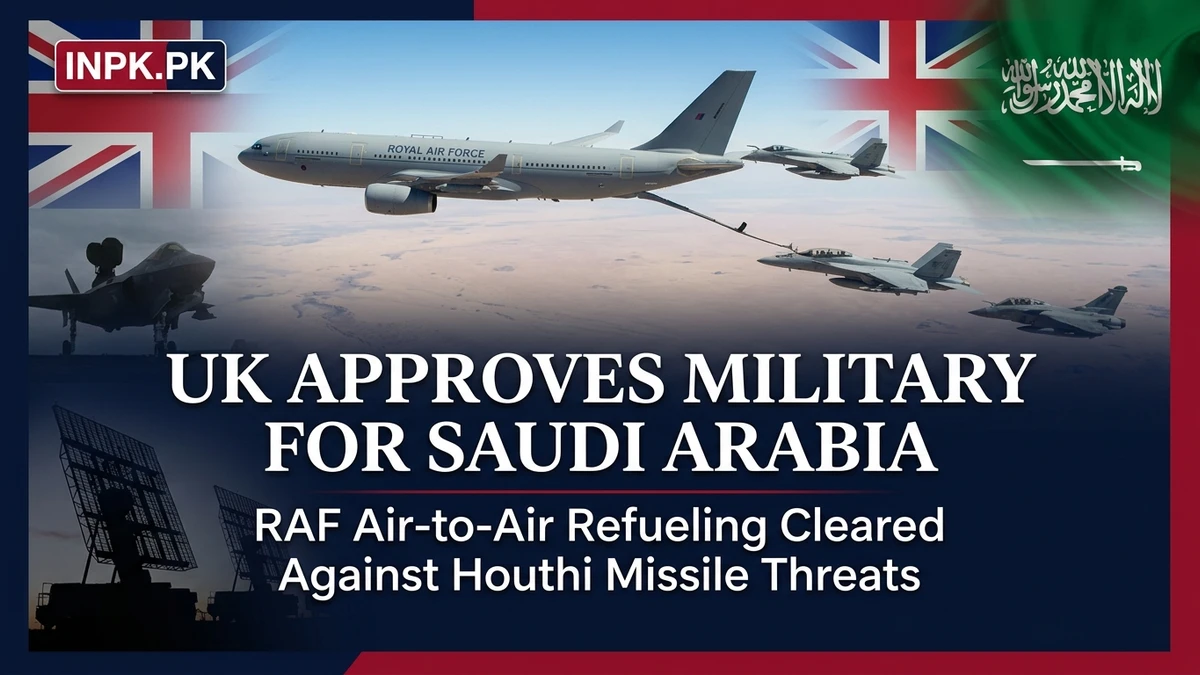
British Prime Minister Andy Burnham announced on Tuesday that the United Kingdom has formally agreed to provide defensive military assistance to Saudi Arabia, deploying Royal Air Force (RAF) Voyager multi-role tanker transport aircraft to conduct air-to-air refueling operations for Royal Saudi Air Force fighter jets defending national airspace against cross-border missile and drone barrages.
The bilateral defense arrangement, confirmed by Downing Street following bilateral discussions with Saudi defense officials in Riyadh, is designed to enhance the sustained operational endurance of Saudi air defense patrols. In recent weeks, regional security has deteriorated following intensified drone and ballistic missile strikes launched from Yemen by Houthi forces targeting strategic energy infrastructure and urban centers across the Arabian Peninsula.
Extending Air Defense Patrol Endurance
Under the operational terms established between the UK Ministry of Defence and the Saudi Ministry of Defense, RAF Voyager KC2 and KC3 tankers operating from regional staging bases will establish refueling tracks in designated international and Saudi airspace. The aerial refueling capability will allow Saudi Eurofighter Typhoon and F-15 Eagle interceptors to remain on combat air patrol for extended intervals without returning to base for fuel replenishment.
British defense officials emphasized that the deployment is strictly defensive in nature and focused solely on airspace protection. The mission scope excludes any involvement in offensive air-to-ground strikes inside Yemen, adhering strictly to international humanitarian law and existing multilateral security resolutions.
"The security of sovereign partners and the stability of global energy corridors remain paramount international priorities," Prime Minister Burnham stated during an address in Westminster. "Our armed forces will support air-to-air refueling operations exclusively for defensive missions aimed at protecting civilian populations, critical infrastructure, and international air traffic from unmanned aerial threats and incoming ballistic strikes."
Escalating Red Sea and Gulf Aerial Threats
The announcement arrives amid heightened tension across the wider Middle East, where commercial shipping routes in the southern Red Sea and critical infrastructure facilities in the Gulf have faced continuous drone and anti-ship missile attacks. While naval task forces continue safeguarding commercial lanes in the Bab al-Mandeb strait, regional defense planners have raised alerts over coordinated long-range drone swarms directed toward civilian aviation corridors and petrochemical refineries.
Saudi air defense brigades have intercepted multiple incoming projectiles using Patriot missile batteries and airborne fighter sweeps, but the high frequency of launches has placed intense operational demands on interceptor squadrons. The integration of RAF air-to-air refueling enables round-the-clock combat air patrols over vulnerable flight paths, closing potential low-altitude penetration corridors used by one-way attack drones.
Diplomatic Realignments and Regional Stability
The agreement reflects a strategic consolidation of defense ties between London and Riyadh amid shifting Western security commitments in the Gulf. Analysts note that the deployment underscores the United Kingdom's role as a primary defense partner for Gulf Cooperation Council states, particularly in integrated radar surveillance, early warning integration, and aerial logistics.
Downing Street affirmed that the RAF commitment will be reviewed periodically in coordination with international partners and regional allies. Diplomatic envoys reiterated that the ultimate resolution to the conflict requires a comprehensive political settlement facilitated by the United Nations to restore permanent regional peace.
Readers can monitor evolving diplomatic proceedings, defense agreements, and Middle East security developments through continuous updates on INPK world news coverage.