
By Web Desk
New York
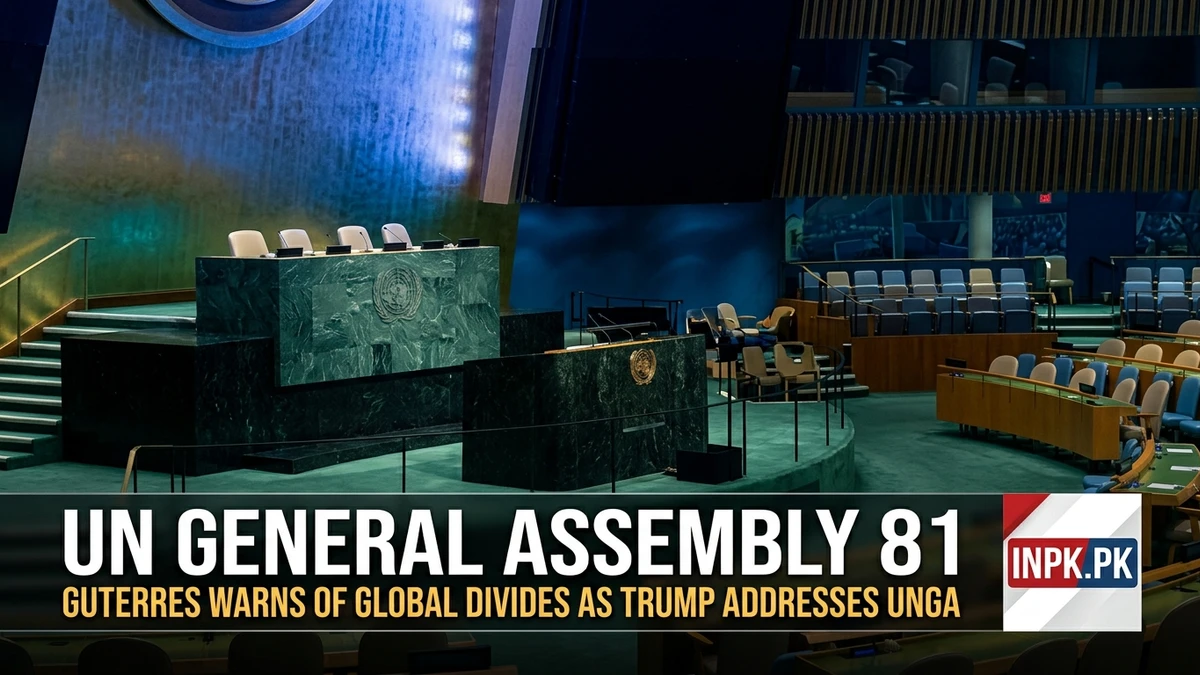
The 81st session of the United Nations General Assembly high-level debate opened at UN Headquarters in New York on Tuesday, marked by starkly contrasting visions for global order as outgoing Secretary-General Antonio Guterres delivered an urgent warning against widening geopolitical canyons and United States President Donald Trump asserted an uncompromising doctrine of peace through strength.
Addressing world leaders in what represents his final General Assembly keynote before concluding his second tenure, Secretary-General Guterres cautioned that international diplomacy faces unprecedented peril. He underscored that regional hostilities, the accelerating climate emergency, and the ungoverned proliferation of artificial intelligence are pushing multilateral institutions to the brink of systemic paralysis.
Guterres Warns Global Fault Lines Turning into Canyons
In a direct appeal to the assembled heads of state and foreign ministers, Guterres asserted that traditional geopolitical guardrails are rapidly eroding under the pressure of nationalist rivalries and unilateral power projections. He delivered a sharp rebuke to coercive foreign policies, emphasizing that military dominance cannot resolve interconnected global emergencies.
"Our world is entering an era of dangerous multipolarity where division is hardening into permanent hostility," Guterres declared from the iconic green marble podium. "The fault lines in our international system have turned from cracks into deep canyons. A might-makes-right approach will not secure lasting peace, nor can it contain cross-border ecological disruptions or regulate technologies that outpace international law."
Guterres reiterated his call for comprehensive institutional reform, arguing that the UN Security Council must be restructured to reflect 21st-century demographic and economic realities. He also proposed an emergency multilateral framework to govern frontier artificial intelligence, warning that military applications of autonomous systems pose an existential risk to international stability if left unregulated.
Trump Emphasizes Peace Through Strength and Delivers Iran Warning
Following the Secretary-General, President Donald Trump delivered an address focused on American sovereign strength, economic competitiveness, and unilateral conflict resolution. Trump argued that strong sovereign states, rather than multilateral bureaucracy, serve as the true foundation of global equilibrium.
Touting his administration's foreign policy record, Trump claimed credit for averting regional conflicts through decisive deterrence and robust economic measures. A significant portion of his address was dedicated to the Middle East, where he issued a stern warning regarding the ongoing standoff with Iran and attacks against international energy routes.
"We have restored American deterrence across the globe through sheer national strength," Trump stated during his address. "No nation should mistake our restraint for hesitation. When critical corridors are threatened or state-sponsored destabilization imperils regional commerce, the United States will take whatever measures are required to protect our allies and guarantee security."
High-Stakes Sideline Diplomacy
With more than 130 heads of state and government convened in Manhattan, the annual General Assembly high-level week serves as a focal point for intense diplomatic maneuvering. Parallel discussions among G7 and regional delegations concentrated on securing vital maritime corridors in the Red Sea and Gulf, sustaining humanitarian corridors in eastern Europe and Africa, and stabilizing global energy supplies amid continuous industrial disruptions.
Diplomatic envoys from South Asia also held key bilateral sessions on the sidelines. Pakistani Foreign Minister Ishaq Dar met with Saudi Foreign Minister Prince Faisal bin Farhan to review regional security cooperation and reaffirm bilateral commitments under the Makkah Joint Defense Agreement, highlighting the critical role of coordinated regional partnerships.
As the high-level debate continues through the week, delegates face the daunting task of bridging ideological divides between traditional multilateral consensus and surging unilateral statecraft. Observers note that the outcomes of bilateral meetings held throughout the summit will significantly influence regional alliances and security architectures heading into 2027.
Stay informed on international diplomacy, multilateral summits, and high-level global policy debates with continuous updates on INPK world news coverage.