
By Web Desk
Washington
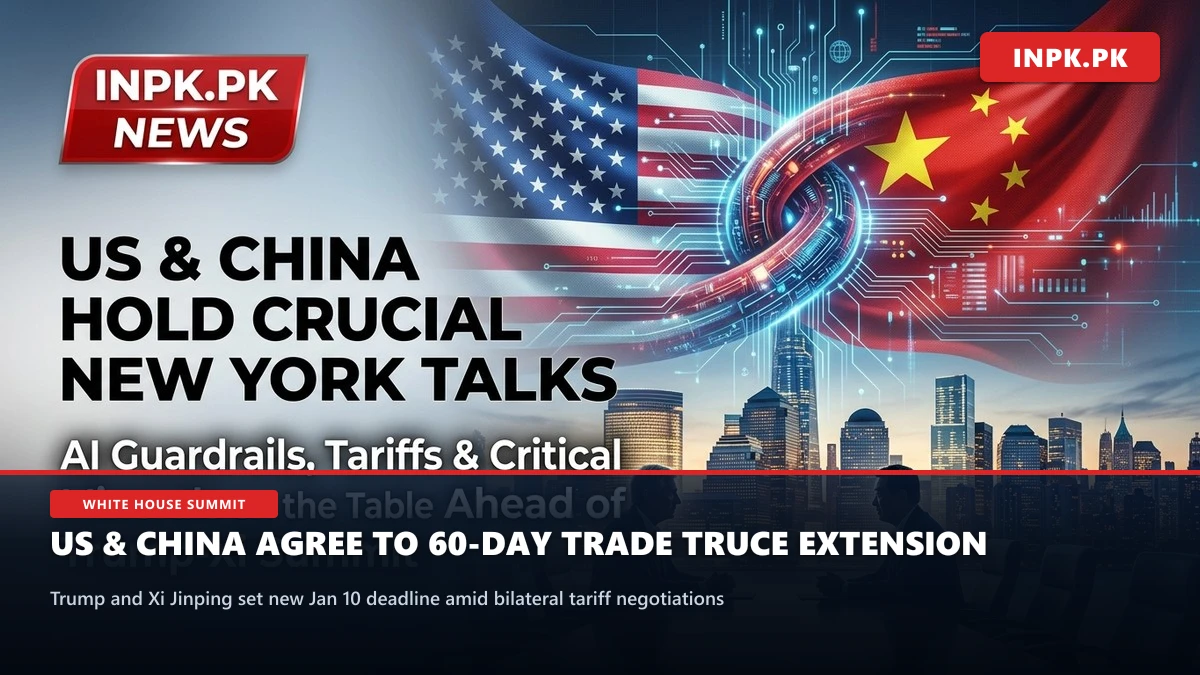
United States President Donald Trump and Chinese President Xi Jinping have concluded high-stakes bilateral summit talks at the White House by formally agreeing to extend their mutual trade truce by two months, setting a new negotiation deadline of January 10, 2027, as both global economic superpowers seek to prevent an uncontrolled resurgence of punitive import tariffs.
The bilateral agreement, announced following five hours of closed-door plenary sessions and working discussions between senior cabinet officials in the East Room, provides immediate short-term relief to international supply chains. However, the relatively brief 60-day extension underscores deep-seated structural impasses over industrial subsidies, critical technology transfer barriers, and persistent bilateral trade deficits between Washington and Beijing.
Tariff Freeze Preserved Under Fragile Working Framework
Under the parameters finalized by US Trade Representative delegates and Chinese Vice Premier negotiators, Washington has agreed to suspend the implementation of proposed 25 percent surcharges across an estimated $180 billion in Chinese consumer electronics and industrial machinery. In reciprocal fashion, Beijing confirmed it will postpone retaliatory tariff escalations targeting American agricultural exports, particularly soybeans, sorghum, and pork shipments from Midwestern producers.
Speaking to accredited correspondents following the bilateral meetings, President Trump characterized the dialogue as constructive while maintaining that long-term tariff exemptions remain contingent on enforceable procurement quotas and currency stabilization benchmarks.
"We have established a workable pathway forward with President Xi and his delegation, but American manufacturing and intellectual property will remain fully protected," Trump stated. "The 60-day window gives our trade teams the operational space to finalize formal purchase commitments and verify trade compliance before any permanent tariff rollbacks take effect."
Chinese state media reported that President Xi emphasized mutual economic interdependence during the plenary exchange, urging Washington to reject zero-sum trade postures and abandon unilateral restrictions on advanced semiconductor manufacturing tools and commercial artificial intelligence platforms.
Frontier Artificial Intelligence and Semiconductor Security Dialogue
Beyond traditional commodity flows and agricultural quotas, summit delegations dedicated significant time to national security friction points surrounding emerging technologies. Negotiators confirmed the creation of a specialized bilateral consultation mechanism focused on safety protocols, catastrophic risks, and export guardrails for frontier artificial intelligence models.
The inclusion of artificial intelligence oversight marks an unprecedented development in formal US-China trade negotiations. Both sides recognized that the rapid militarization and autonomous deployment of advanced algorithmic systems pose shared destabilization hazards to international security. Technical working groups are scheduled to convene in Geneva next month to draft preliminary governance frameworks addressing autonomous weapons limitations and critical digital infrastructure security.
Simultaneously, the Chinese delegation raised formal objections regarding expanding US Commerce Department restrictions on advanced graphics processing units and extreme ultraviolet lithography exports. American officials countered by expressing grave concern over Beijing tightening export quotas on rare earth elements, gallium, and germanium, which remain essential for Western aerospace and defense supply chains.
Global Market Reaction and Long-Term Economic Outlook
Financial markets across Asia and Europe registered cautious reactions to the summit conclusion. While benchmark energy contracts eased slightly on expectations of trade continuity, regional equities in Shanghai and Hong Kong surrendered early gains as institutional investors calculated that the short 60-day reprieve leaves significant macroeconomic uncertainty unresolved heading into early 2027.
Global trade economists emphasize that while the Washington summit averted an immediate tariff shock, fundamental divergences regarding state-led industrial policies and high-tech sovereignty remain largely intact. Sustained economic stability will depend on whether bilateral negotiating groups can produce binding agreements during scheduled second-round sessions in Singapore late November.
Follow ongoing coverage of international diplomacy, multilateral summits, and global financial markets with regular updates on INPK world news coverage and in-depth corporate analysis at INPK business news.