
By Web Desk
New York
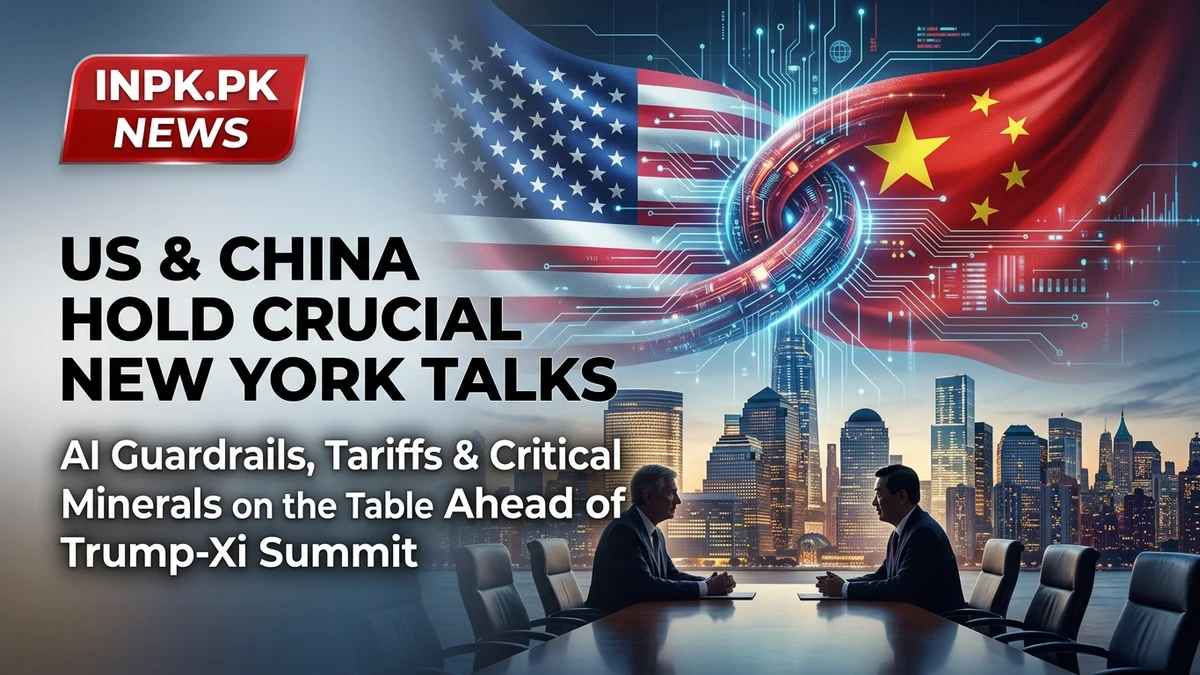
Senior economic and diplomatic envoys from the United States and the People's Republic of China convened in Manhattan on Sunday for intensive, closed-door negotiations aimed at stabilizing bilateral trade, establishing governance guardrails for artificial intelligence, and preventing a renewed tariff war ahead of this week's highly anticipated presidential summit in Washington.
The high-level discussions, held at JPMorgan Chase headquarters in New York City, brought together U.S. Treasury Secretary Scott Bessent, U.S. Trade Representative Jamieson Greer, and Chinese Vice Premier He Lifeng. The meetings represent the critical preparatory phase for the bilateral summit between President Donald Trump and President Xi Jinping scheduled for September 24 at the White House.
Artificial Intelligence Governance and Safety Guardrails
A central pillar of the New York dialogue focused on establishing reciprocal safety standards and technical guardrails around rapidly evolving artificial intelligence architectures. Officials familiar with the negotiations indicated that discussions encompassed both open-weight and proprietary closed-weight foundational models, addressing concerns regarding the potential proliferation of advanced dual-use AI capabilities to unauthorized non-state entities.
Treasury Secretary Bessent underscored the necessity of establishing baseline communication channels between American and Chinese AI safety institutes, seeking to mitigate systemic risks while navigating competitive technological export controls maintained by Washington.
Trade Truce Expiration and Tariff Negotiations
The talks arrive against a critical calendar deadline: the temporary bilateral trade truce agreed upon by Washington and Beijing is formally scheduled to expire on November 10, 2026. Negotiators reviewed compliance with earlier trade commitments, including Beijing's structural purchasing targets for American agricultural commodities, manufactured aerospace components, and Boeing commercial aircraft.
Discussions centered on potential reciprocal tariff adjustments across non-strategic consumer goods in exchange for binding assurances on supply chain access. However, American negotiators reiterated concerns that Chinese shipments of rare-earth magnets and processed critical minerals have remained below agreed delivery benchmarks, emphasizing that sustained export predictability is essential to maintaining tariff stability.
Geopolitical Pressures and Global Energy Volatility
The bilateral economic agenda was further complicated by mounting instability across global energy logistics, exacerbated by the ongoing conflict in the Middle East and tanker disruptions along the Persian Gulf. Negotiators addressed macroeconomic spillover effects, container shipping bottlenecks, and joint efforts to manage global inflationary pressures impacting both domestic economies.
While financial markets remain cautiously optimistic regarding diplomatic engagement, analysts emphasize that neither side anticipates a comprehensive resolution to deep-seated technological and industrial rivalries. Instead, the New York summit is aimed at creating a predictable framework to prevent unintended economic escalations during the upcoming Trump-Xi bilateral summit.
Readers can monitor evolving diplomatic proceedings, trade policy announcements, and international market reactions through continuous updates on INPK world news coverage.