
By Web Desk
Lahore
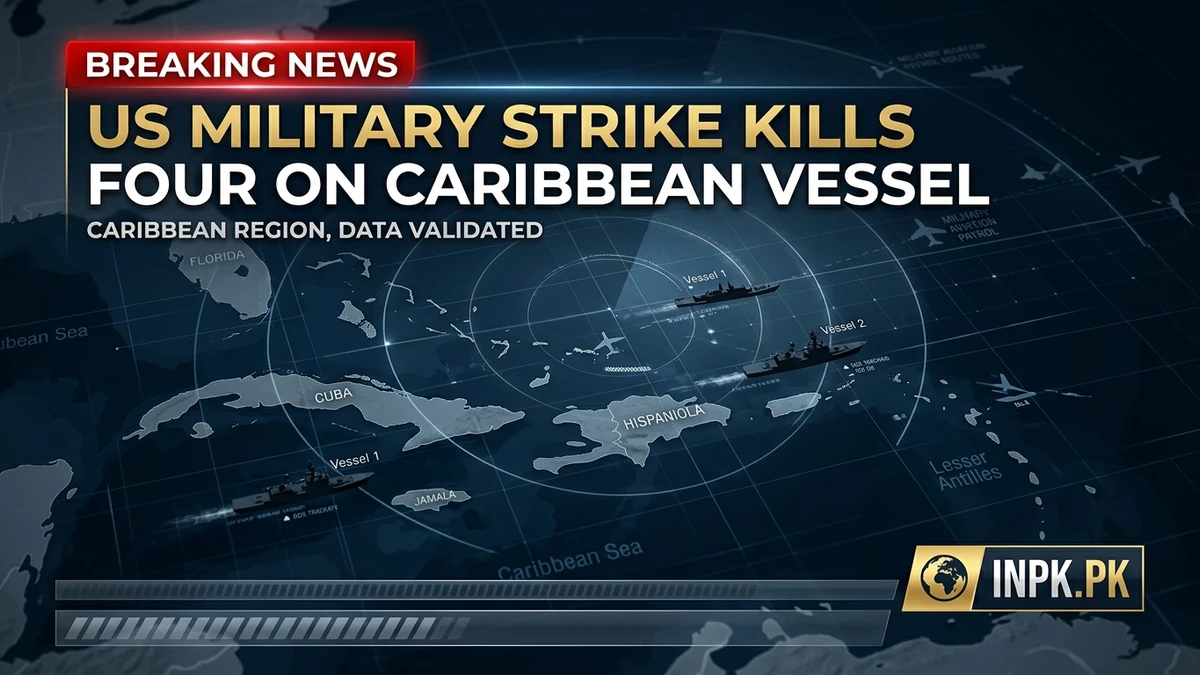
A United States military strike targeting a suspected drug-trafficking vessel in international waters of the Caribbean Sea has killed four individuals, defense officials confirmed on Saturday, marking the latest deadly engagement under the expanded counter-narcotics campaign known as "Operation Southern Spear."
United States Southern Command (SOUTHCOM) stated that military assets conducted a precision kinetic engagement after aerial reconnaissance identified a high-speed craft navigating international maritime corridors without visible national identifiers. Military spokespersons claimed intelligence assessments confirmed the vessel was carrying illicit narcotics and classified the crew members as "narco-terrorists" operating on behalf of transnational criminal syndicates.
Escalating Death Toll Under 'Operation Southern Spear'
The lethal engagement elevates the reported casualty count from militarized maritime interdictions in the Caribbean and Eastern Pacific to at least 231 deaths since the launch of Operation Southern Spear in late 2025. Initiated under executive directives from the Trump administration, the campaign authorized the Pentagon to employ military-grade kinetic force against suspected smuggling vessels rather than relying solely on traditional Coast Guard boarding, search, and seizure procedures.
Defense officials maintain that the aggressive posture is vital to disrupting maritime trafficking corridors that fund violent cartels and flood North American markets with fentanyl and cocaine. Joint task forces comprising naval destroyers, surveillance drones, and armed helicopters have substantially increased operational patrols across the Western Hemisphere over the past twelve months.
Legal Controversies and Extrajudicial Scrutiny
The continued reliance on lethal strikes in international waters has drawn sharp criticism from international legal scholars, maritime law experts, and human rights organizations. Critics contend that targeting civilian vessels with lethal munitions without verified self-defense triggers or opportunities for lawful surrender bypasses established legal due process and risks violating the international law of the sea.
Humanitarian monitors have repeatedly called for independent judicial reviews and the public disclosure of forensic evidence, noting that previous strikes resulted in disputed casualties and lack transparent post-engagement accounting. Several Caribbean and Latin American governments have privately expressed unease regarding the militarization of regional shipping lanes without multilateral consultation.
Regional Security and Multilateral Implications
The strike unfolds against a backdrop of heightened regional geopolitical maneuvering across the Caribbean basin, where Washington has sought to assert maritime primacy and curb the influence of extra-hemispheric powers in regional ports. Coast Guard and naval commands have indicated that maritime surveillance operations will maintain maximum patrol frequency in the weeks ahead.
Readers can follow verified developments, international legal reactions, and global security coverage on INPK news coverage as regional diplomatic responses emerge.