
By Web Desk
Washington
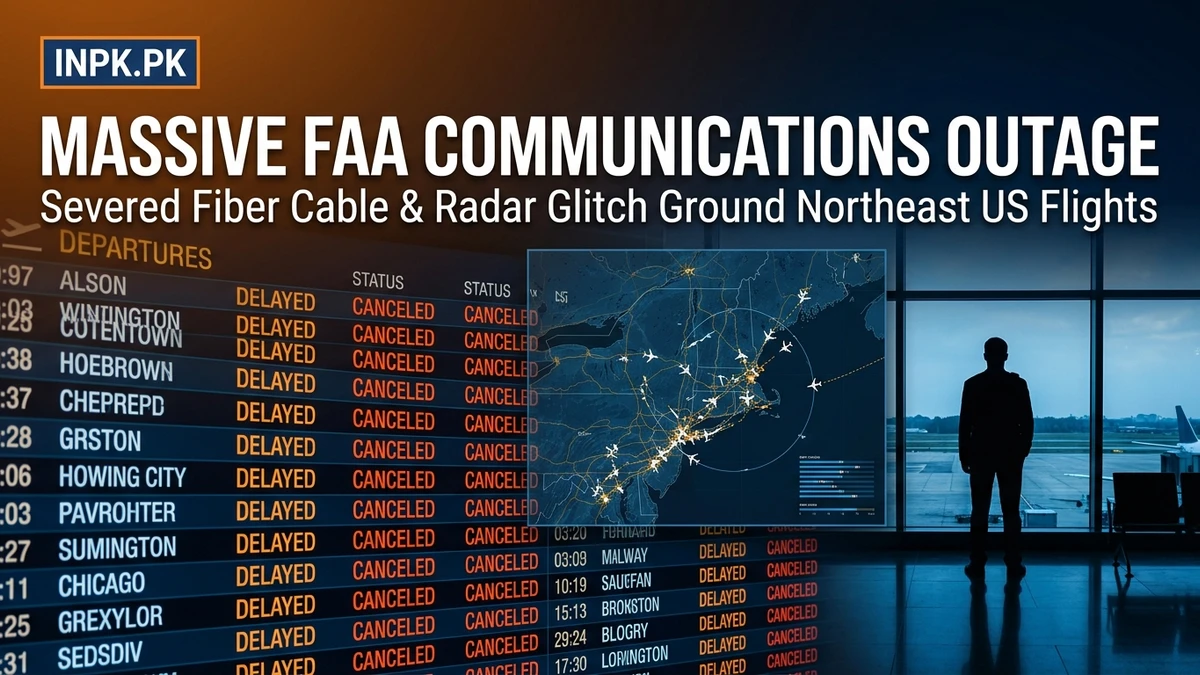
A catastrophic dual communications failure at a key Federal Aviation Administration (FAA) regional control facility triggered widespread ground stops and severe flight cancellations across the northeastern United States on Monday and Tuesday, leaving thousands of passengers stranded at major metropolitan airports.
The aviation disruption originated at the Philadelphia Terminal Radar Approach Control (TRACON) facility, which manages approach and departure operations across eastern Pennsylvania, southern New Jersey, and northern Delaware. According to federal officials, an internal telecommunications circuit collapsed unexpectedly, cutting controller radar feeds and two-way voice frequencies with airborne commercial aircraft.
Compounded by Severed Backup Fiber-Optic Line
While FAA facilities maintain redundant failover architectures, emergency transfer protocols failed when technicians discovered that the primary secondary backup line had been physically severed earlier in the day. Preliminary findings indicate that a railway infrastructure contractor operating heavy excavation equipment between Newark and New Brunswick, New Jersey, inadvertently sliced through a high-capacity subterranean fiber-optic trunk line.
The simultaneous loss of both primary and secondary data channels forced air traffic controllers to transition to manual procedural separation protocols, drastically reducing arrival and departure rates across one of the busiest airspace corridors in North America. The FAA promptly issued mandatory ground stops for flights bound for Philadelphia International Airport, Newark Liberty International Airport, and New York's John F. Kennedy International and LaGuardia airports.
"Safety remains our absolute and non-negotiable benchmark," Transportation Secretary Sean Duffy stated during an emergency briefing in Washington. "When visual and radio verification circuits dropped offline, air traffic management acted decisively to hold aircraft on the ground to prevent loss of safe separation. We have initiated an immediate federal inquiry into infrastructure protection protocols and contractor excavation permits along essential telecommunication easements."
Widespread Operational Gridlock and Passenger Delays
Aviation tracking services reported over 2,400 flight delays and more than 480 cancellations across the East Coast corridor before technical crews successfully spliced the severed fiber cables late Monday evening. Major carriers, including Delta Air Lines, United Airlines, and American Airlines, issued extensive travel waivers, warning passengers that ripple effects would persist throughout Tuesday as flight crews and displaced aircraft are repositioned.
Regional commuter hubs, including Boston Logan International Airport and Baltimore/Washington International Airport, experienced rolling delays as aircraft bound for New York and Philadelphia were diverted or held at origin gates. Airport terminals witnessed long lines at rebooking desks, with airline ground personnel working through overnight backlogs.
Infrastructure Resilience and Safety Inquiries
The incident has intensified scrutiny over the resilience of the nation's aging air traffic infrastructure. Lawmakers on the House Transportation and Infrastructure Committee called for an urgent review into why secondary backup lines were routed along commercial railway corridors without adequate physical protection from third-party excavation crews.
FAA technical teams reported that full redundant data feeds have been restored, and airspace operational limits have returned to normal flow rates. However, airline industry analysts caution that comprehensive schedule recovery will require another 24 to 36 hours as flight operations teams realign international connections and pilot duty-hour rotations.
Travelers can track ongoing aviation updates, transport policies, and breaking developments through INPK US news coverage.